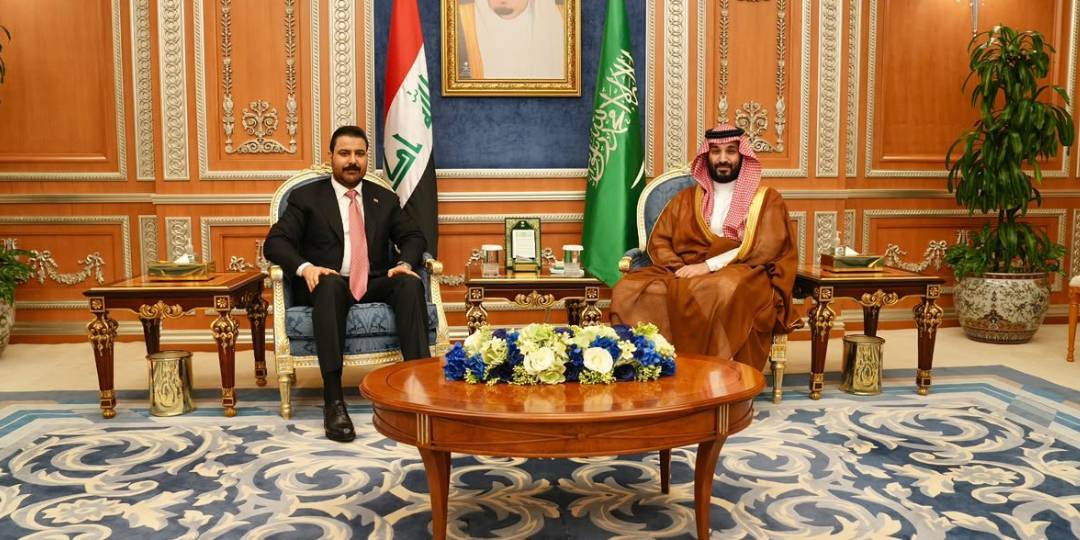

Prime Minister Ali Falah Al-Zidi concluded an official diplomatic mission to Riyadh and returned to Baghdad on Wednesday, following substantive consultations with the Crown Prince of the Kingdom of Saudi Arabia, Prince Mohammed bin Salman bin Abdulaziz Al Saud. The bilateral meeting centered on reviewing regional security developments, harmonizing political stances, and advancing collaborative frameworks to preserve collective peace across the Middle East.
The high-level Iraqi Prime Minister’s visit to Saudi Arabia delivered clear diplomatic messages, as Al-Zidi renewed Iraq’s condemnation of the armed strikes that hit King Khalid International Airport in Riyadh. The prime minister stressed that the targeting of civilian infrastructure and non-combatants represents a dangerous threat to regional stability that must be rejected across all diplomatic forums.
Addressing the Saudi leadership directly, Al-Zidi affirmed Iraq’s consistent stance barring any entity from utilizing Iraqi territory or sovereign airspace as a launching pad for hostile actions against Saudi Arabia or neighboring states. He reiterated Baghdad’s commitment to the foundational principles of good neighborliness, mutual respect for state sovereignty, and proactive bilateral security coordination.
Diplomatic Outcomes of the Iraqi Prime Minister’s Visit to Saudi Arabia
According to an official communique issued by the Prime Minister’s Media Office, the talks between Al-Zidi and Crown Prince Mohammed bin Salman covered a broad agenda aimed at developing ties between the two nations across political, economic, and security fields.
The leaders focused on establishing operational coordination mechanisms between Iraqi and Saudi security agencies to respond effectively to rapid regional changes. Both sides underscored the importance of sharing intelligence, securing borders, and preventing unauthorized armed groups from exploiting border areas to destabilize regional peace.
Strategic Security Commitments Affirmed in Riyadh
– Refusing to allow Iraqi soil or airspace to be used for aggression against Saudi Arabia or neighboring nations.
– Condemning attacks against King Khalid International Airport and all strikes on civilian infrastructure during armed conflicts.
– Adhering to the principles of good neighborliness, international law, and mutual respect for national sovereignty.
– Developing rapid bilateral security coordination to counter cross-border threats and protect strategic transport corridors.
Saudi Endorsement of Iraq’s Stabilizing Role
Crown Prince Mohammed bin Salman expressed Saudi Arabia’s appreciation for Baghdad’s clear stance in condemning attacks on civilian facilities. He confirmed the Kingdom’s backing for the Iraqi government’s initiatives to promote diplomatic dialogue and de-escalate tensions across the region.
The Crown Prince noted that Saudi Arabia values its partnership with Iraq, emphasizing Riyadh’s readiness to expand commercial cooperation, joint infrastructure investments, and energy projects. He noted that a secure, prosperous Iraq serves as an essential pillar for the stability of the entire region.
Key Pillars of Iraq-Saudi Strategic Partnership
– Expanding bilateral trade volume and accelerating joint private sector investments in energy and municipal infrastructure.
– Reinforcing operational border security, modernizing crossing points, and securing overland transport networks.
– Supporting Iraqi diplomatic mediation aimed at narrowing viewpoints among regional actors.
– Maintaining high-level political consultations to align perspectives on international affairs.
Regional Stability and Iraq’s Balanced Foreign Policy
The outcome of the Riyadh summit reflects Iraq’s ongoing effort to pursue a balanced foreign policy that keeps the country out of regional conflicts while serving as an interlocutor for peace. Baghdad’s foreign policy doctrine emphasizes national interest, regional economic integration, and the rejection of military escalation.
Security analysts emphasize that Iraq’s commitment to protecting the security of its neighbors stems from an understanding that domestic stability is linked to regional tranquility. Closer coordination between Baghdad and Riyadh helps protect the Arabian Peninsula and the wider region from widening confrontations, safeguarding energy markets and civil aviation networks.
Conclusion:
The Iraqi Prime Minister’s visit to Saudi Arabia reinforces an era of trust and practical coordination between Baghdad and Riyadh. By affirming that Iraqi territory will not be used to launch attacks against the Kingdom and condemning strikes on civilian infrastructure, Iraq demonstrates its commitment to good neighborliness, while Saudi support for Iraqi dialogue initiatives strengthens the foundation for long-term regional stability.