
Iraq’s Ministry of Oil confirmed that progress on the accelerated gas investment in Artawi field (AG25) in Basra Governorate has reached 96% completion, positioning the facility to enter commercial operations in the near future. The development forms an integral part of Baghdad’s broader push to capture associated gas, eliminate flaring, and channel dry gas directly into the national power grid to feed domestic power generation plants.
Concurrently, the ministry has accelerated upstream exploration and development across oil and gas blocks awarded under the fifth-plus and sixth licensing rounds. Executive leadership reaffirmed long-term upstream plans to progressively scale up crude production capabilities toward targets exceeding 10 million barrels per day through intensive seismic evaluations, exploratory drilling, and integrated field development programs.
Gas Investment in Artawi Field Approaches Commercial Operation
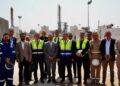
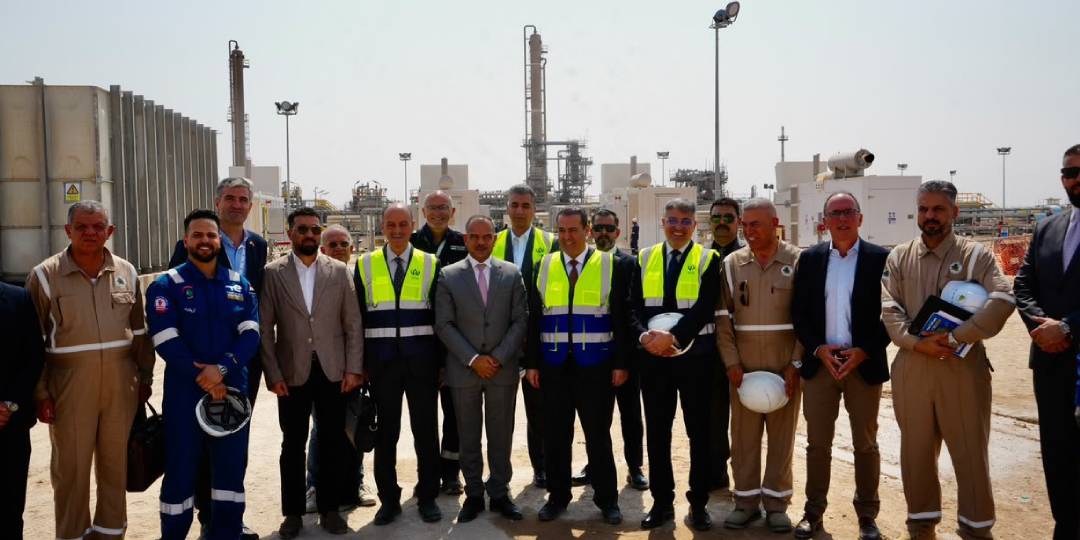
Deputy Minister of Oil for Gas Affairs Izzat Saber Ismail conducted a comprehensive field inspection of the Artawi development in Basra to review operational milestones across gas gathering and processing units. Accompanied by the Director General of South Gas Company alongside project leads from Basra Oil Company and operating contractors, Ismail evaluated the final stages of the accelerated gas scheme (AG25).
The project, executed in partnership with French multi-energy company TotalEnergies, is engineered to process 50 million standard cubic feet per day (MMSCFD) of raw sour gas extracted from the Yamama reservoir. Once processed, the facility will supply over 40 MMSCFD of dry gas directly to the national power grid, providing immediate fuel supplies for thermal power stations and reducing reliance on fuel imports.
Scope and Phasing of the Central Gas Processing Plant (GMP)
Ismail also inspected the central Gas Processing Plant (GMP) within the field complex, where construction activities have attained approximately 35% completion. The central facility is designed to serve multiple southern fields under a multi-phase framework:
– Phase 1 Processing Capacity: Treating 300 MMSCFD of associated gas sourced from Majnoon, West Qurna 2, and Artawi fields.
– Phase 2 Expansion: Adding an equivalent 300 MMSCFD processing train using gas captured from adjacent producing fields.
– Environmental Impact: Eliminating routine gas flaring in compliance with Iraq’s sovereign decarbonization commitments.
– Grid Integration: Pipelining dry sales gas to domestic power facilities while recovering natural gas liquids (NGLs) and condensate for commercial use.
Upstream Strategy to Expand Crude Oil Output Capacity
In a parallel meeting, Deputy Minister of Oil for Upstream Affairs Naseer Aziz Jabbar convened an expanded session with department heads, state-owned oil companies, and international operating partners. Acting on directives from Minister of Oil Basim Khudair Al-Abadi, Jabbar outlined the government’s master plan to systematically scale up crude oil extraction capacity.
Jabbar emphasized that reaching upstream production targets beyond 10 million barrels per day requires clear execution timelines, modern reservoir management techniques, and swift resolution of contractual and logistical challenges encountered by operating contractors.
Strategic Priorities for Upstream Licensing Rounds
– Seismic Analysis: Accelerating 2D and 3D seismic data acquisition and evaluation across remote exploration blocks.
– Appraisal Drilling: Fast-tracking exploratory and appraisal wells to confirm commercial discoveries and reserve additions.
– Contractor Support: Providing regulatory, administrative, and logistical facilitation to maintain agreed milestone schedules.
– Technology Transfer: Integrating advanced reservoir modeling and extraction technology via enhanced collaboration between Iraqi state personnel and international operators.
Conclusion:
The near-completion of the gas investment in Artawi field demonstrates concrete progress in Iraq’s strategy to monetize natural gas reserves and curb wasteful flaring across southern oil fields. In parallel with expanded upstream licensing round exploration, the Ministry of Oil is pursuing a dual energy path: securing domestic feedstock for electricity while safeguarding long-term crude production and export capacities.