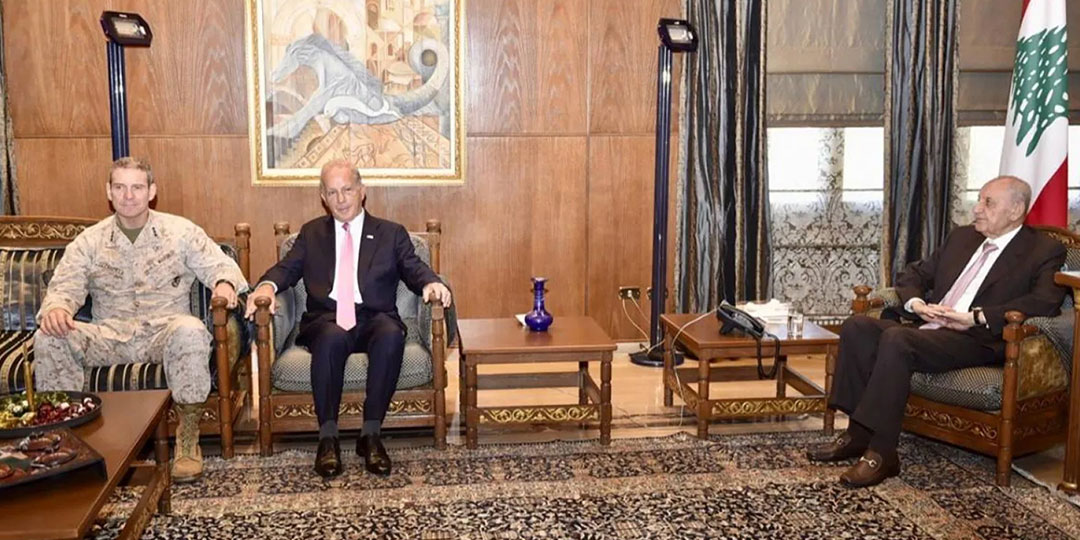

Lebanese Prime Minister Nawaf Salam on Thursday met General Joseph Clearfield, head of the Military Coordination Group for Lebanon (MCG4L), to discuss developments in the south amid continued military tension and Israeli attacks in border areas.
Salam stressed during the meeting the need to stop Israeli destruction in the south, expand the trial zones there and set a clear timetable for Israeli withdrawal from Lebanese territory.
Call for an end to destruction and a withdrawal timetable
The Lebanese prime minister said the situation in the south requires an immediate halt to destruction operations, along with an expansion of the trial areas linked to mechanisms verifying Israeli withdrawal and the deployment of the Lebanese army.
His remarks come as Beirut says the ceasefire arrangements remain incomplete, with tensions still running high along the southern border.
Background to the ceasefire deal
Lebanon signed a ceasefire agreement with Israel in June, mediated by the United States, which called for a halt to hostilities and a gradual Israeli withdrawal from the south.
The agreement also included field arrangements related to military deployment and verification mechanisms, as part of efforts to de-escalate the situation and prevent renewed clashes.
Berri raises the issue with Clearfield
In a separate meeting, Lebanese Parliament Speaker Nabih Berri discussed the situation in the south and the group’s work with General Clearfield, in light of the start of work to define trial zones and verify Israeli withdrawal and Lebanese army deployment.
According to a statement from parliament, Berri said Israel has not stopped its violations and attacks on Lebanon and the south since November 2024, and that the attacks have continued in a systematic manner.
Accusations of village and farmland destruction
Berri said Israeli attacks have included destroying villages, bulldozing farmland and agricultural areas, and burning forested zones, as well as targeting heritage sites and cultural landmarks.
He said the key to stability remains forcing Israel to stop its war and withdraw to the international border.
Framework agreement and search for a lasting path
Lebanon and Israel signed a “framework agreement” on June 26 to lay the groundwork for ending the state of war and beginning a negotiating path toward lasting peace and security, despite continued Israeli attacks and the occupation of villages and towns in the south within what is known as the “yellow line.”
The process is meant to set out practical and political arrangements that could help stabilise the situation and support a gradual withdrawal under agreed monitoring mechanisms.
Conclusion:
The latest developments in the south highlight the continued political and diplomatic efforts to contain tensions with Israel, while Lebanese officials insist on ending attacks and securing a clear timetable for withdrawal. The south remains tightly linked to verification mechanisms, military deployment and post-ceasefire arrangements.