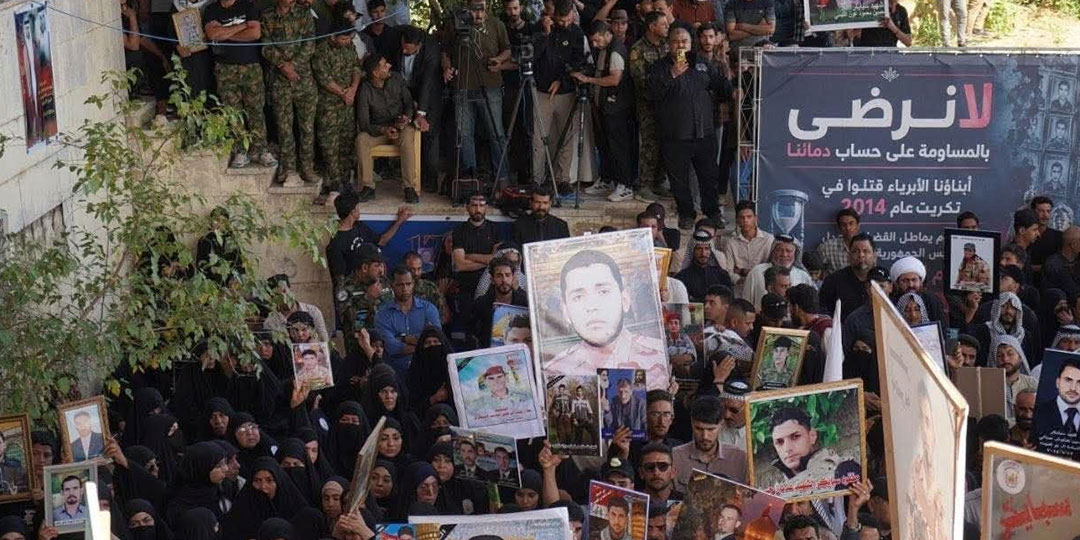

Iraqi officials marked the anniversary of the Speicher massacre, describing it as a lasting testament to the brutality of terrorism and renewing calls for national unity and justice.
President Nizar Amidi said the tragedy will remain a stark reminder of ISIS crimes against the Iraqi people, while Prime Minister Ali Faleh Al-Zaidi inaugurated a dedicated Speicher panorama to honor the victims.
President: A Symbol of Terrorism’s Brutality
In a statement carried by the Iraqi News Agency, President Amidi said the Speicher massacre represents one of the most painful chapters in Iraq’s modern history.
He stressed that the victims, who were killed by ISIS militants, will remain a symbol of sacrifice and resilience.
The president also highlighted the historic role of the religious authority’s fatwa of jihad al-kifai, which helped unify Iraqis in confronting terrorism and defending the country.
He offered condolences to the families of the victims and emphasized the importance of strengthening national unity to protect Iraq from future threats.
Prime Minister: Terrorists Tried to Destroy the Idea of the State
Prime Minister Al-Zaidi inaugurated the Speicher panorama, created by Iraqi artist Hanoush Hanoush, describing the massacre as a deep wound in the heart of the nation.
He said extremist forces aimed to undermine the concept of the Iraqi state and erode public trust through the atrocity.
According to the Prime Minister, the terrorists sought to turn pain into division, but failed because the victims’ blood united Iraqis rather than dividing them.
He added that true loyalty to the victims lies in building a just and strong state capable of protecting its citizens.
Political Leaders Call for Accountability
On the twelfth anniversary of the massacre, Iraqi political figures reiterated demands to pursue and prosecute those responsible.
Hadi Al-Amiri, Secretary-General of the Badr Organization, described the massacre as one of the most heinous crimes in Iraq’s history and called for continued legal action against all remaining perpetrators.
Qais Al-Khazali, Secretary-General of Asa’ib Ahl Al-Haq, said the crime was not only an attack on individuals but an attempt to fracture Iraq’s unity and morale.
Both leaders emphasized the importance of ensuring full rights and support for the victims’ families.
Security Forces Honor the Fallen
Deputy Commander of Joint Operations, Lt. Gen. Qais Al-Mohammadawi, stated that the Speicher massacre remains a painful mark on Iraq’s collective memory.
He said the blood of the victims played a crucial role in mobilizing efforts to defeat ISIS and restore territorial control.
Al-Mohammadawi stressed that honoring the victims requires ongoing support for their families and continued pursuit of terrorists to ensure justice.
A Defining Moment in Iraq’s Fight Against Extremism
The Speicher massacre, which took place in 2014 near Salah al-Din province, resulted in the killing of thousands of military cadets by ISIS militants.
Iraqi leaders describe it as a defining moment that reshaped the country’s response to extremism and strengthened national resolve.
Key themes emphasized during the commemoration include:
– Preserving national unity.
– Supporting victims’ families.
– Strengthening state institutions.
– Rejecting extremism and sectarian division.
Conclusion:
The anniversary of the Speicher massacre serves as both a moment of remembrance and a reaffirmation of Iraq’s commitment to justice and unity. Iraqi leaders underscored that the victims’ sacrifices remain central to the country’s determination to confront terrorism and build a stable, secure future.