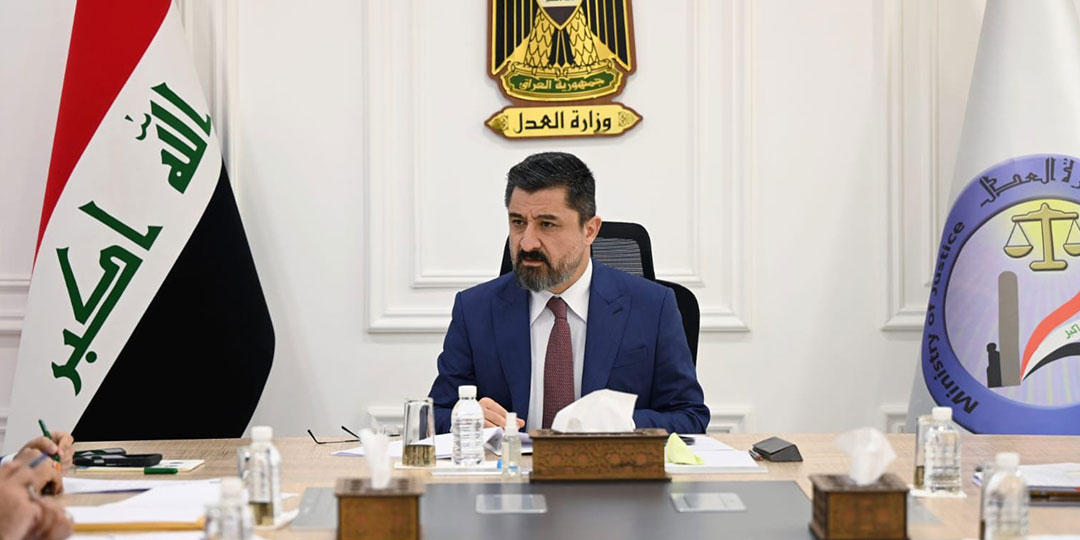

Iraq’s Justice Minister Khalid Shwani has directed the preparation of the National Human Rights Plan 2026–2030, with the draft to be submitted to the Council of Ministers for approval.
The directive came during a meeting with senior staff of the Human Rights Department, where the ministry outlined its strategic vision and work program for the coming phase, according to a statement carried by the Iraqi News Agency.
Annual Reporting and Improved Data Standards
The minister instructed the department to present periodic annual reports to monitor implementation of the plan.
He emphasized the need to improve the quality of official reports by relying on accurate indicators and verified data, in order to strengthen Iraq’s standing within the UN Human Rights Council and other regional and international bodies.
Shwani also stressed aligning reporting practices with modern mechanisms adopted by the United Nations for preparing and drafting periodic human rights reports.
Key directives included:
– Drafting a comprehensive national plan for 2026–2030.
– Submitting the plan to the Cabinet for approval.
– Issuing annual monitoring reports.
– Establishing a digitized archive and database covering all human rights files.
Capacity Building and Monitoring Mechanisms
The minister called for building the capacity of personnel working in human rights across ministries and public institutions to ensure Iraq meets its international obligations.
He highlighted the importance of preparing accurate responses to questionnaires and reports required by international organizations, and activating monitoring teams to enhance human rights conditions in correctional institutions.
The ministry also aims to coordinate the drafting of related legislation to support these objectives.
Reform of Juvenile Correctional Institutions
In a related development, Shwani directed the completion of infrastructure development projects in juvenile correctional institutions.
During a meeting with senior officials from the Juvenile Reform Department, he discussed strategic plans to modernize facilities and improve services in line with the government program.
The minister underscored:
– Completing modern correctional complexes.
– Expanding education and rehabilitation programs for juveniles.
– Activating aftercare programs for released individuals to support reintegration and reduce reoffending.
Accelerating Digital Transformation
Shwani also stressed the need to accelerate digital transformation within the Juvenile Reform Department by adopting electronic systems and establishing remote trial centers connected to relevant authorities via video conferencing technology.
He concluded by calling for integrated plans that enhance security stability and improve service delivery within correctional institutions.
Conclusion:
The launch of the National Human Rights Plan 2026–2030 marks a new phase in Iraq’s institutional reform efforts, focusing on improved reporting standards, digital transformation, and modernization of correctional facilities. The Ministry of Justice aims to align domestic practices with international commitments while strengthening oversight and rehabilitation mechanisms.