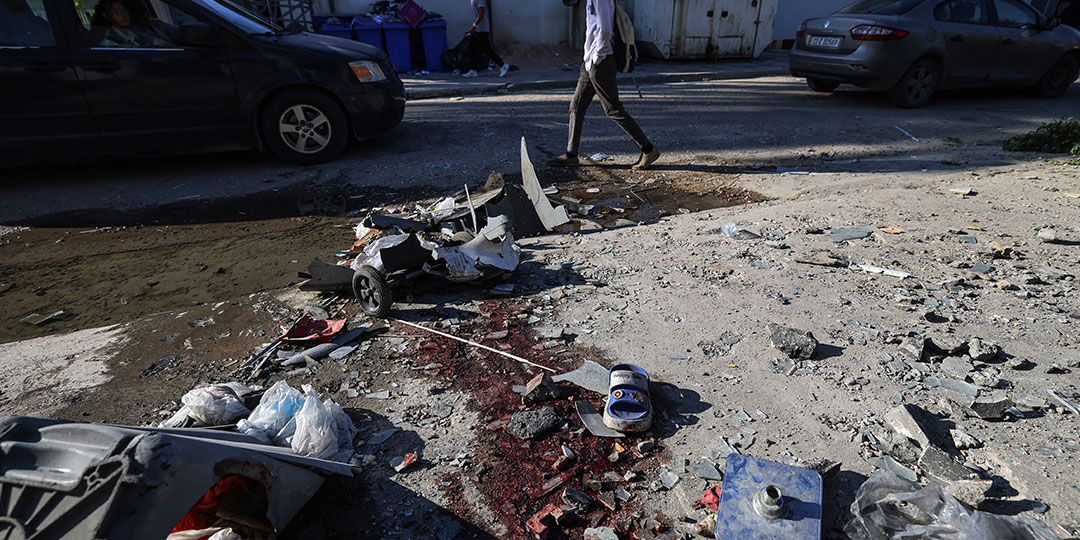

Five explosions rocked central Baghdad late Tuesday, with AFP journalists confirming blasts originating from the area where the U.S. embassy is located, as the newly announced two-week U.S.-Iran ceasefire took effect. The blasts preceded reports of civilian casualties across Iraq, with at least seven people killed including an eight-year-old child in separate incidents, according to official sources. Two civilians, including the child, were killed when a projectile struck their home in Baghdad’s western Amiriya district, causing a fire that claimed additional lives and injured three others. In southern Iraq near the Kuwait border, at least three civilians died in strikes on Khor Al-Zubair, with neighbors reporting five people in the targeted house but only three bodies recovered, raising questions about additional casualties. In Iraqi Kurdistan, a bomb-laden drone from Iran crashed into a civilian home, killing a couple, prompting Erbil Governor Omed Khoshnaw to characterize the attack as “a violation of international law and a war crime.” The wave of civilian casualties occurring as the ceasefire officially commenced underscores the danger of the two-week arrangement’s limits and raises questions about whether the pause will actually reduce violence or merely create a temporary lull in ongoing hostilities. The incidents suggest that pro-Iran groups and other belligerents may not yet have received orders to halt all operations, or that enforcement of the ceasefire across diverse armed actors remains uncertain.
The timing of civilian deaths concurrent with ceasefire announcement signals the fragility of the agreement and the risks that two weeks may prove insufficient for establishing durable de-escalation.
Five Explosions Strike Central Baghdad Near U.S. Embassy
AFP journalists confirmed Tuesday night that five explosions were heard in central Baghdad’s area where the U.S. embassy compound is located. The blasts represented the first significant attack on U.S. interests in Baghdad since the ceasefire announcement earlier that day.
The embassy and a U.S. diplomatic and logistics center at Baghdad’s airport have been repeatedly targeted by rockets and drones launched by pro-Tehran armed groups since the start of the U.S.-Israeli war against Iran. Most attacks have been intercepted by air defense systems, though the Tuesday night blasts represent successful penetration of defenses or attacks on less-protected targets.
Pattern of Targeting U.S. Diplomatic Facilities
The repeated targeting of U.S. embassy and airport facilities reflects strategic focus by pro-Iran armed groups on disrupting American diplomatic presence and military logistics in Iraq. The attacks demonstrate persistent hostile intent despite the ceasefire announcement, suggesting coordination difficulties or delays in ceasefire implementation.
Two Civilians, Including Child, Killed in Baghdad
A police source told AFP that two civilians, including an eight-year-old child, were killed late Tuesday when a projectile crashed into their home in Baghdad’s western Amiriya district, causing a fire. Three additional civilians, including a woman, were wounded in the strike.
A security official confirmed to AFP that “a rocket fell on a house in the Amiriya district,” providing official acknowledgment of the incident. The targeting of a residential home raises humanitarian concerns regarding civilian protection during ongoing hostilities.
Impact on Children and Vulnerable Populations
The death of an eight-year-old child exemplifies the civilian toll of the conflict. The child represents one of multiple young casualties occurring across Iraq during the ceasefire period, raising questions about protection mechanisms for vulnerable populations and whether the ceasefire extends to all armed actors.
Three Civilians Killed in Southern Iraq Near Kuwait Border
A strike killed at least three civilians Tuesday in southern Iraq near the Kuwait border, in the city of Khor Al-Zubair near Basra. Thaer al-Salhi, a member of Basra’s provincial council, reported:
“A house was bombed by a plane in the city of Khor Al-Zubair, according to eyewitnesses. Neighbours say there were five people living in the house—three men, a woman and a child—but only three bodies have been found so far.”
Disputed Casualty Figures and Missing Persons
The discrepancy between reported residents and recovered bodies raises concerns regarding complete casualty accounting. Neighbors’ reports suggesting five inhabitants versus three bodies recovered indicate potential missing persons or incomplete rescue operations.
A security official confirmed that missile strikes on the house had been fired from Kuwait, complicating attribution of responsibility. If strikes originated from Kuwait, the question arises regarding coordination between different regional actors and whether all parties respect the ceasefire.
Kuwaiti Consulate Storming and Protest Response
Hours after the strikes on Khor Al-Zubair, protesters attempted to storm the Kuwaiti consulate in Basra, with security forces responding by firing tear gas, according to an AFP photographer who witnessed the incident. The attack on Kuwaiti facilities reflects Iraqi public anger regarding casualties attributed to Kuwaiti territory-based strikes.
Couple Killed in Iraqi Kurdistan by Iranian Drone
In Iraqi Kurdistan, a bomb-laden drone originating from Iran crashed into a civilian home early Tuesday, killing a couple, according to local authorities. Iraqi Kurdistan’s Counter-Terrorism Service stated in a statement:
“The incident took place on Monday when a bomb-laden drone coming from Iran crashed into a civilian home in the Dara Shakran subdistrict within Erbil Province.”
International Law Violation Allegations
Erbil Governor Omed Khoshnaw stated in a Facebook post that the civilians’ deaths amounted to “a violation of international law and a war crime,” formally characterizing the attack as violating humanitarian law protections for civilian populations.
The designation as war crime carries significant legal implications, suggesting intent to pursue accountability mechanisms and international legal remedies for attacks on civilians.
Ceasefire Implementation Challenges
The multiple civilian casualties occurring within hours of the ceasefire announcement raise questions about ceasefire implementation and coordination across diverse armed actors. The incidents suggest that:
- Not all armed groups may have received ceasefire directives
- Coordination delays may prevent simultaneous implementation across all forces
- Some groups may continue operations before receiving orders
- Enforcement mechanisms may be inadequate to halt all violence immediately
Two-Week Timeframe Limitations
The two-week ceasefire duration limits the agreement’s ability to establish sustained de-escalation. If ceasefire enforcement remains incomplete during the initial period, the brief timeframe may prove insufficient to build confidence or resolve underlying disputes.
Civilian Impact and Humanitarian Toll
The pattern of civilian casualties across Baghdad, southern Iraq, and Kurdish regions demonstrates that the ceasefire has not immediately halted attacks on civilian populations. The deaths of an eight-year-old child in Baghdad, additional civilians in Khor Al-Zubair, and a couple in Kurdistan within hours of ceasefire announcement signal continued risks to civilian safety.
Vulnerable Populations and Protection Gaps
Children and women represented disproportionate shares of reported casualties, reflecting vulnerability of less-protected populations. The incidents suggest that civilian protection mechanisms remain inadequate even as ceasefire arrangements supposedly reduce hostilities.
Attribution and Strike Verification Challenges
The southern Iraq strikes attributed to Kuwaiti territory raise questions regarding accurate attribution of responsibility. Security officials attributed strikes to origins in Kuwait, complicating determination of which belligerent conducted the operation and whether Kuwait’s territory was used with knowledge or consent.
Cross-Border Attack Implications
If strikes originated from Kuwait against targets in Iraq, the incident raises questions regarding:
- Coordination among regional actors regarding ceasefire implementation
- Border security and territorial sovereignty
- Third-party involvement in escalating or continuing hostilities
- Compliance of non-principal parties with ceasefire agreements
Pro-Iran Armed Groups and Ceasefire Compliance
The explosions in central Baghdad near the U.S. embassy suggest that pro-Iran armed groups may not have fully ceased operations despite the ceasefire announcement. The timing of attacks concurrent with ceasefire implementation raises questions regarding:
- Coordination delays between Tehran and proxy forces in Iraq
- Autonomy of Iraqi-based militias regarding operational decisions
- Enforcement mechanisms ensuring compliance with ceasefire directives
Proxy Force Control and Strategic Messaging
The continued attacks suggest either delayed transmission of ceasefire directives to proxy forces or deliberate continuation of limited operations to maintain pressure on adversaries. The attacks may represent efforts to demonstrate continued capability and resolve despite diplomatic arrangements.
International Response and War Crimes Allegations
The characterization by Erbil Governor Khoshnaw of the Iranian drone attack as a “war crime” signals intent to pursue international accountability. The designation suggests potential future legal proceedings through international courts or tribunals addressing violations of humanitarian law.
Documentation and Evidence Gathering
Iraqi authorities’ careful documentation of civilian casualties and attack details suggests preparations for potential international legal proceedings. The emphasis on civilian status and property damage aims to establish factual records supporting war crimes allegations.
Humanitarian and Civilian Concerns
The attacks on civilian homes and resulting deaths raise fundamental humanitarian concerns regarding:
- Distinction between civilian and military targets
- Proportionality of attacks relative to military advantage
- Precautions to minimize civilian harm
- Accountability for violations of humanitarian law
Medical and Emergency Response
The incidents overwhelmed local medical facilities and emergency response capacity, with reports of wounded civilians requiring treatment. The ceasefire arrangement does not appear to include humanitarian provisions facilitating medical assistance or evacuation of casualties.
Ceasefire Fragility and Escalation Risks
The incidents occurring within hours of ceasefire announcement demonstrate the arrangement’s fragility. If similar incidents continue throughout the two-week period, confidence in the ceasefire may erode, potentially triggering resumed escalation or unilateral withdrawal by one or both parties.
Escalation Triggers and Risk Management
The ceasefire lacks apparent enforcement mechanisms or escalation controls to prevent:
- Unilateral attacks by proxy forces
- Accidental or unintended strikes
- Miscalculation by lower-level commanders
- Retaliation for perceived violations
Questions Regarding Strike Authorization
The continued strikes raise questions regarding whether senior commanders authorized the attacks or whether lower-level actors continued operations independently. If senior-level authorization is required for ceasefire compliance, the incidents suggest either authorization failures or breakdown in command authority.
Conclusion:
Five explosions struck central Baghdad late Tuesday as the newly announced two-week U.S.-Iran ceasefire took effect, with subsequent reports of at least seven civilian deaths including an eight-year-old child across Iraq. Two civilians were killed in Baghdad’s Amiriya district when a projectile struck their home, three were killed in southern Iraq near the Kuwait border, and a couple died in Iraqi Kurdistan when an Iranian drone crashed into their residence. The pattern of civilian casualties occurring within hours of ceasefire announcement underscores the arrangement’s fragility and raises fundamental questions regarding ceasefire implementation, enforcement mechanisms, and protection of civilian populations. The continued attacks on U.S. diplomatic facilities, residential areas, and civilian populations suggest that pro-Iran armed groups and other belligerents have not fully halted operations or received complete ceasefire directives. Attribution challenges, particularly regarding strikes attributed to Kuwaiti territory, raise questions about regional coordination regarding the ceasefire. Iraqi authorities’ characterization of the Iranian drone attack as a “war crime” signals intent to pursue international accountability. The two-week timeframe appears insufficient to resolve humanitarian concerns or establish durable de-escalation, with risks that resumed violence will follow ceasefire expiration absent diplomatic breakthrough addressing underlying disputes. The incidents demonstrate that civilian protection remains inadequate even as major powers negotiate ceasefires, highlighting the urgent need for humanitarian provisions and enforcement mechanisms ensuring compliance across all armed actors.