
Oil prices rise in early Asian trade on Wednesday as ongoing violence in the Middle East disrupts supplies and fuels global economic anxiety. The renewed escalation around the Strait of Hormuz, one of the world’s most critical energy corridors, has pushed crude benchmarks higher and sent shockwaves across stock markets worldwide.
The conflict involving the United States, Israel, and Iran has intensified concerns among investors, particularly with crude shipments slowing through the Hormuz waterway.
Oil prices climb as Hormuz tensions escalate
West Texas Intermediate gained 0.5 percent to reach 74.92 dollars, while Brent crude, which surged above 85 dollars per barrel on Tuesday for the first time since July 2024, later settled at 81.40 dollars but remained up 4.7 percent.
The spike follows ongoing military operations by the United States and Israel against Iran, which have severely disrupted tanker movements. The Strait of Hormuz, responsible for transporting nearly one fifth of global crude, has experienced a drastic reduction in traffic since Saturday.
Analysts say speculation continues about the possibility of Brent reaching 100 dollars per barrel if the conflict widens.
Washington moves to secure shipping lanes
US President Donald Trump announced that the US Navy will escort oil tankers through the Strait of Hormuz if required and directed Washington to provide insurance for commercial shipping.
These steps prompted some easing in crude prices late Tuesday although energy costs remain significantly elevated.
Global stock markets hit by volatility
Equities across the world suffered steep declines driven by concerns over energy prices, inflation risks, and the widening conflict.
US markets cut losses after initial rout
Wall Street experienced heavy early losses before moderating after Trump’s announcement.
The S&P 500 closed down 0.9 percent at 6,816.63 while the Dow dipped 0.8 percent. The Nasdaq Composite fell 1 percent.
Art Hogan of B. Riley Wealth Management said the easing in crude prices helped stabilize US equities.
Europe suffers major declines
European markets faced a severe sell-off as investors digested the inflationary risks of the Iran conflict.
London’s FTSE 100 fell 2.8 percent, while Paris and Frankfurt dropped more than 3 percent.
Eurozone core inflation climbed unexpectedly adding pressure on the European Central Bank. Economists warned that a prolonged conflict could spike inflation further and slow growth.
Natural gas prices surge across Europe
The Dutch TTF gas benchmark surged more than 40 percent to its highest level since January 2023.
This followed a 50 percent jump earlier in the week after Qatar’s state-run energy company halted LNG production due to labor strikes.
Asian markets respond with steep declines
Stock markets across Asia extended losses triggered by the Middle East conflict and soaring oil prices.
Hong Kong and Tokyo slide sharply
Hong Kong’s Hang Seng Index fell nearly 3 percent to 24,984.87 as investors voiced inflation concerns linked to rising energy costs.
Tokyo’s Nikkei 225 ended down 3.1 percent. Shanghai’s Composite also recorded losses.
South Korea’s Kospi suffers worst two-day drop since 2008
South Korea’s Kospi index fell 12.6 percent to 5,065.14 in early afternoon trading following a 7.2 percent drop on Tuesday.
The combined fall marks its worst two-day performance since the global financial crisis.
South Korea is one of the world’s largest importers of Middle Eastern crude which makes it heavily vulnerable to supply shocks.
The index had previously risen over 50 percent this year driven by investor demand for AI-related stocks.
Gulf markets reopen sharply lower
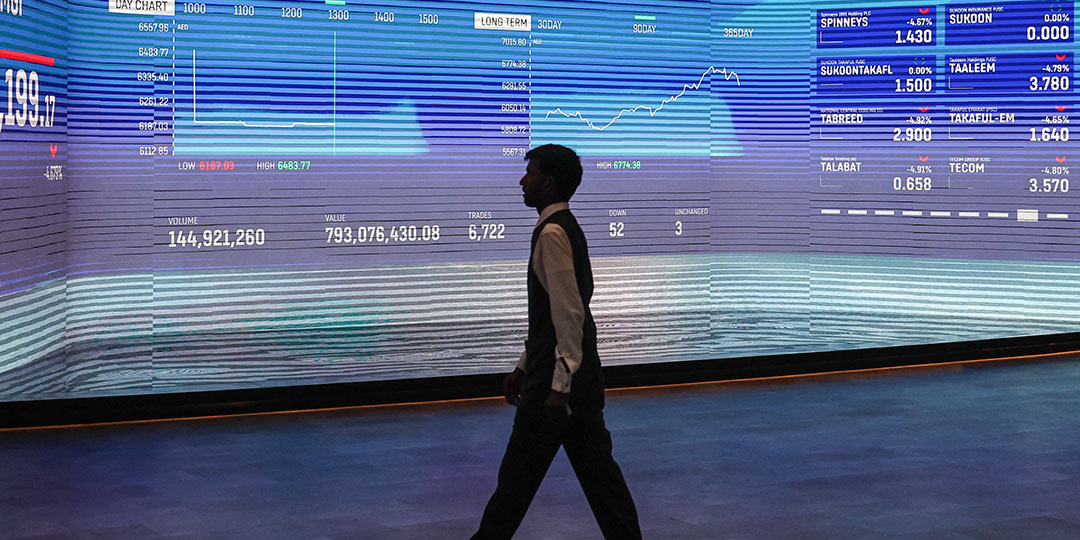
The Dubai and Abu Dhabi exchanges, which were suspended for two days after Iranian missile and drone attacks across the Gulf, reopened to significant declines.
Dubai’s market fell 4.7 percent and Abu Dhabi’s ADX dropped 3.5 percent shortly after the opening.
Conclusion:
Global markets continue to navigate significant volatility as the Middle East conflict injects uncertainty into energy supply routes and inflation outlooks. Analysts warn that instability in the Strait of Hormuz could prolong market turbulence in the weeks ahead.