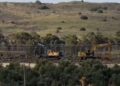
In a rugged area near the Syrian-Lebanese border, bulldozers belonging to the Syrian army are building earthen barriers behind which armored vehicles are stationed, while soldiers comb through tunnels they say were used by Hezbollah during the years of the Syrian conflict. This comes as part of military reinforcements amid the ongoing war in the Middle East.
Damascus is seeking to distance itself from the war that has spread to neighboring Lebanon, where Hezbollah is engaged in a deadly conflict with Israel.
In the countryside of Al-Qusayr in western Syria, an AFP photographer—granted access by the Defense Ministry to document the army’s deployment along the border for the first time since reinforcements were sent about a month ago—observed several cross-border tunnels recently discovered by the army.
Mohammad Hammoud, a Syrian-Lebanese border official, told AFP that the army had uncovered “through sweeping operations in the border areas (…) a network of tunnels linking the two countries, which were used to smuggle weapons and drugs.”
A field commander in the Syrian army confirmed that Hezbollah had used these tunnels.
Hezbollah had fought alongside the forces of former Syrian president Bashar al-Assad during the years of conflict that began in 2011 as a peaceful uprising against the regime and later evolved into a bloody war.
An AFP photographer saw at least five tunnels stretching between the two sides, including one that begins in the basement of a house, accessed by concrete steps leading to narrow, dark passageways used for crossing.
In rugged mountainous areas, other tunnels were equipped with الكهرباء and ventilation systems.
In one of the houses leading to tunnel entrances, portraits of former Hezbollah Secretary-General Hassan Nasrallah—killed by Israel in September 2024—and former Iranian Quds Force commander Qassem Soleimani—killed by the United States in January 2020—were still hanging on the walls.
The Al-Qusayr area in Homs province has been strategically important as a link between Homs, the Lebanese border, and supply routes through the Bekaa Valley in eastern Lebanon. It became a major stronghold for Hezbollah for years after its military intervention starting in 2013.
On March 28, Syrian authorities announced the discovery of a tunnel near a village west of Homs connecting Syrian territory to Lebanon, noting that “Lebanese militias” had used it for smuggling before the army shut it down.
Since the overthrow of Assad in December 2024 by a coalition of Islamist opposition factions led by President Ahmed al-Sharaa, Hezbollah’s supply lines through Syria have been cut. The new Syrian authorities say they are coordinating with the Lebanese side to combat smuggling and control border crossings.
- No intention of military action –
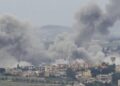
Israel has repeatedly said it has carried out strikes on border crossings between the two countries in order to cut supply routes to Hezbollah.
An AFP correspondent observed sites damaged by previous Israeli strikes, including destroyed buildings near one of the tunnels, while Syrian soldiers were conducting foot patrols in the area.
On March 4, Syrian authorities announced reinforcing army deployment along the border with Lebanon, sending “armored vehicles, soldiers, rocket launchers, and reconnaissance units to monitor border activities and combat smuggling,” with the aim of “protecting and controlling the border” amid escalating regional conflict.
Hammoud said the mission of the deployed forces is limited to “securing the border.”
According to a diplomatic source, “pressure was exerted on the Damascus government to intervene in Lebanon to end Hezbollah’s threat in the region, but it refused” to do so.
A Syrian military source confirmed to AFP on Wednesday that the army has “no intention of carrying out any military action,” and that its mission is currently limited to border control.
He added that the reinforcements include artillery, armored vehicles, machine gun-equipped units, and infantry forces, describing the deployment as “within the normal scope.”
Despite Syria not being directly involved in the regional conflict, the country has witnessed limited tensions related to it.
On March 10, Damascus condemned Hezbollah for firing artillery shells from Lebanese territory at Syrian army positions near Serghaya, west of Damascus. On the same day, Syrian President Ahmed al-Sharaa and Lebanese President Joseph Aoun stressed in a phone call the need to “control the border” and prevent “any security lapses.”
Al-Sharaa reiterated during a meeting with Chatham House in London on Tuesday that his country wants to remain outside the conflict.
He said, “Unless Syria is directly targeted by any party, it will remain outside this conflict. Fourteen years of war are enough for Syria, during which we have paid a very heavy price. We are not prepared to go through a new experience.”