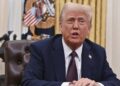
US President Donald Trump announced the immediate increase of global tariffs to 15 percent following a Supreme Court ruling that invalidated key parts of the tariffs his administration previously introduced. The global tariff policy remains one of Trump’s main tools in reshaping US trade relations with major economic partners.
Trump said the new global tariffs are set at the maximum level allowed under current law and follow a review of the court’s decision, which he described as highly unfavorable to US interests. The new rate impacts several trade partners including the European Union, Japan, South Korea, and Taiwan.
Details of Trump’s New Global Tariff Increase
Trump stated on his Truth Social platform that he will raise the global tariff rate from 10 percent to 15 percent with immediate effect. The announcement came one day after he signed an executive order imposing a 10 percent global tariff scheduled to take effect on 24 February for 150 days, with limited exemptions including pharmaceuticals and goods entering the US under the USMCA free trade agreement.
Countries Affected by the New Tariff Level
The new 15 percent tariff applies to trade partners that maintain formal trade agreements with the United States. These include:
- European Union
- Japan
- South Korea
- Taiwan
All of these partners had previously accepted 15 percent as the maximum permissible additional tariff.
European Responses and Calls for Unity
The Supreme Court ruling was welcomed cautiously by US trade partners, although the subsequent tariff hike has triggered concern across Europe. European officials stressed the need for a coordinated response to protect the bloc’s economic interests.
France Calls for a Unified EU Position
French Trade Minister Nicolas Forissier urged the European Union to adopt a unified stance in response to the new US tariffs. Speaking to the Financial Times, he also voiced support for possible retaliatory measures if necessary. The French ministry said EU member states are coordinating with the European Commission to assess the full impact of the US Supreme Court ruling.
Germany Seeks European Coordination before Talks with Trump
German Chancellor Friedrich Merz said he will consult with European allies to prepare a joint response before his upcoming meeting with Trump in Washington. Merz emphasized that Europe must safeguard its economic interests and avoid an escalation in trade tensions.
Legal Background and Supreme Court Objections
The US Supreme Court ruled that Trump overstepped his authority by imposing wide-ranging tariffs using a 1977 law that grants economic emergency powers to the executive branch. Chief Justice John Roberts wrote that the president should obtain explicit authorization from Congress before imposing tariffs of this scale.
Potential Refunds for Companies
The court decision opens the possibility for companies to seek refunds for previously paid tariffs, estimated to have exceeded 130 billion dollars in 2025. Trump said the court did not address this issue directly and suggested that it may take years to resolve in the legal system. Justice Brett Kavanaugh, who dissented, warned that processing such refunds could result in significant administrative complications.
Why This Matters for Iraq and the Region
- Changes in US tariff policy can influence global trade routes and shipping costs which affect import-dependent economies including Iraq.
- Trade tensions between the US and Europe may disrupt supply chains connected to Middle Eastern markets.
Conclusion:
Trump’s decision to raise global tariffs to 15 percent marks a new phase in the trade dispute between the United States and its partners. As the European Union evaluates possible countermeasures and legal debates continue within the United States the broader impact on the global economy remains uncertain.