
Global stocks and oil prices rise as investors respond to stronger-than-expected US industrial production data and ongoing talks between Washington and Tehran. Markets in the United States and Europe closed higher on Wednesday, while crude prices jumped more than three percent amid uncertainty surrounding negotiations over Iran’s nuclear programme.
Investors also looked ahead to the release of minutes from the latest Federal Reserve meeting for signals on the future path of US interest rates. The combination of solid economic data and geopolitical developments shaped trading across global financial markets.
Oil markets reacted sharply to reports related to the US-Iran discussions, reflecting concerns that any escalation in the region could disrupt supplies through the Strait of Hormuz, a key artery for global energy exports.
Wall Street Gains After US Industrial Production Beats Forecasts
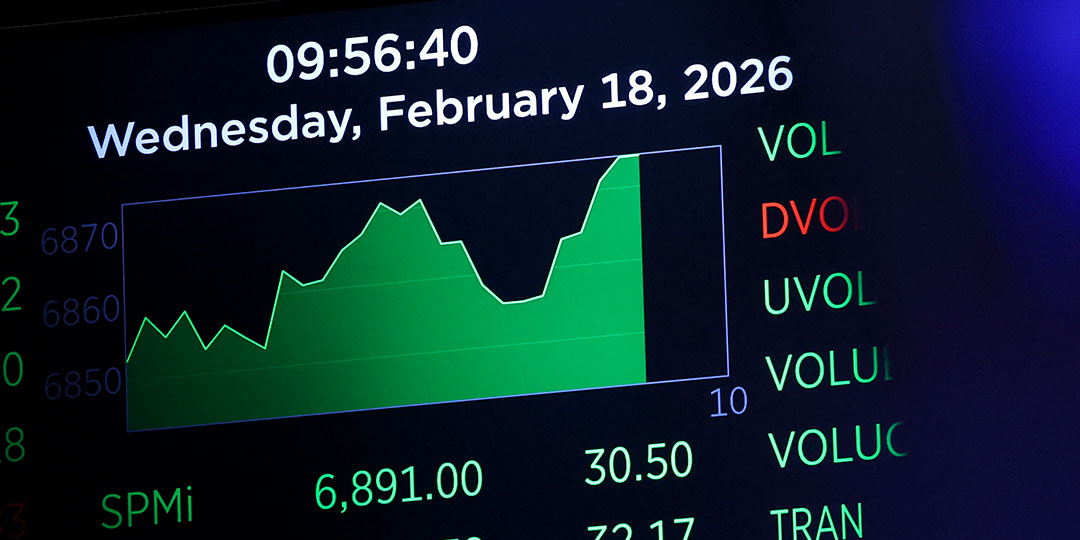
US equities moved higher in afternoon trading, supported by fresh economic data. The Dow Jones Industrial Average rose 0.6 percent to 49,814.74 points, while the S&P 500 gained 0.8 percent to 6,899.58. The Nasdaq advanced 1.3 percent to 22,857.96.
According to the Federal Reserve, US industrial production increased by 0.7 percent in January compared to the previous month, accelerating from a 0.2 percent rise in December. The figure exceeded economists’ expectations of a 0.3 percent increase, as surveyed by Dow Jones Newswires and The Wall Street Journal.
Manufacturing Output Posts Strongest Gain in Nearly a Year
Manufacturing output rose by 0.6 percent in January, marking its strongest monthly increase since February 2025. The gains were broad-based across industry groups, including computer and electronic products as well as motor vehicles and parts.
The Federal Reserve noted improvements in new orders and production. However, analysts cautioned that earlier months saw downward revisions, moderating the overall trend.
Economist Oliver Allen of Pantheon Macroeconomics said much of the year-on-year growth was concentrated in two sectors:
Computer and electronics equipment, supported by investment in artificial intelligence infrastructure
Aerospace equipment, reflecting a recovery at Boeing
Mining output declined by 0.2 percent in January, while utilities output increased by 2.1 percent.
Oil Prices Climb Amid US-Iran Nuclear Talks
Oil prices rose sharply as Washington and Tehran continued discussions over Iran’s nuclear programme. Brent North Sea crude climbed 3.0 percent to $69.48 per barrel, while West Texas Intermediate rose 3.2 percent to $64.35 per barrel.
US Energy Secretary Chris Wright stated that the United States would prevent Iran from acquiring nuclear weapons “one way or the other.” US Vice President JD Vance added that Tehran had not yet acknowledged all of Washington’s red lines.
Market analysts warned that any military escalation could threaten shipping through the Strait of Hormuz. Chris Beauchamp, chief market analyst at IG, said reports pointing to major military action raise the risk of disruption to oil flows, potentially pushing prices significantly higher.
For Iraq, a major oil exporter, sustained increases in global crude prices are closely watched given their direct impact on public revenues and budget planning.
European and Asian Markets Post Broad Gains
European shares recorded solid advances despite geopolitical uncertainty. London’s FTSE 100 led gains, rising 1.2 percent to close at 10,686.18 after data showed UK inflation eased in January. The figures increased expectations that the Bank of England could cut interest rates next month, putting pressure on the pound.
In London trading:
BAE Systems shares rose four percent after reporting higher annual net profit and a record order backlog.
Glencore gained 4.7 percent after announcing a return to profitability last year.
Paris’s CAC 40 briefly set a new record high above its previous peak of 8,437.35 before closing up 0.8 percent at 8,429.03. Frankfurt’s DAX rose 0.9 percent to 25,278.21.
In Asia, Tokyo’s Nikkei 225 advanced 1.0 percent to 57,143.84 after Washington announced an initial $36 billion tranche of Japanese infrastructure investments, part of a broader $550 billion commitment under a trade agreement with US President Donald Trump.
Markets in Hong Kong, Shanghai, Seoul and Taipei were closed for the Lunar New Year holiday.
Currency Markets and Central Bank Signals
The euro weakened against the dollar following a Financial Times report suggesting European Central Bank President Christine Lagarde could step down before the end of her term in October 2027. An ECB spokesperson later said no such decision had been taken.
The dollar strengthened to 154.34 yen from 153.29 yen. The euro fell to $1.1814, while the pound slipped to $1.3535.
Investors now await the release of Federal Reserve meeting minutes for further clarity on US monetary policy, particularly as inflation trends and manufacturing data influence expectations about borrowing costs in the months ahead.
Conclusion:
Global markets closed higher as investors balanced strong US industrial data with ongoing geopolitical risks linked to US-Iran negotiations. While equities advanced, oil prices reacted sharply to regional tensions, underscoring the sensitivity of energy markets to developments in the Middle East.