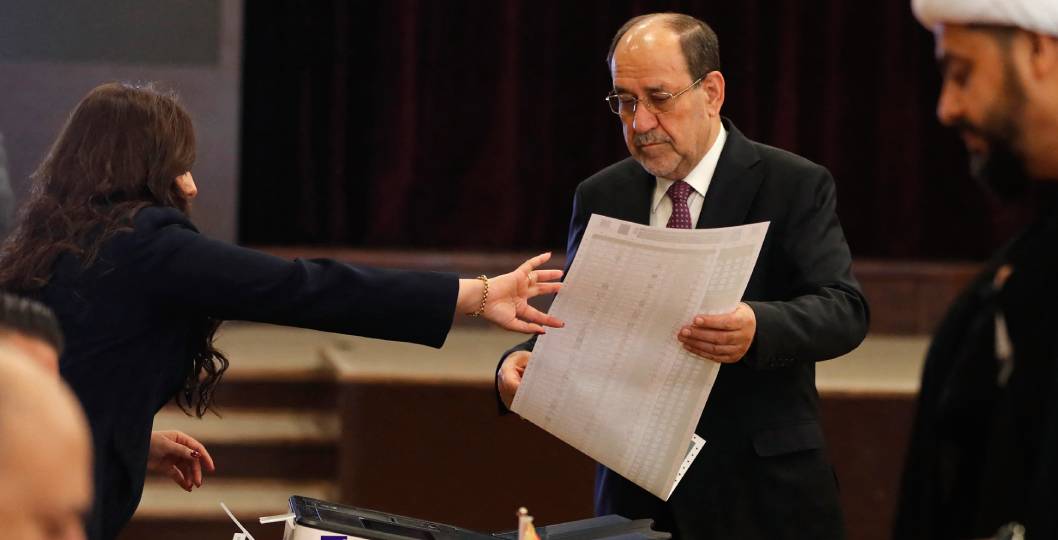

The Coordination Framework’s candidate for prime minister, Nuri al-Maliki, has affirmed that the decision for him to continue or withdraw his candidacy rests exclusively with the Framework, considering any concession due to external pressure a “danger to Iraq’s sovereignty.”
In a televised interview on Tuesday evening, al-Maliki stated that his nomination came through constitutional and legal mechanisms and that the Coordination Framework, as the largest bloc in parliament, is the “rightful party” to proceed with or change the nomination. He added, “If the Framework decides now to change the nomination, I will comply wholeheartedly.”
These statements come after the Coordination Framework, which includes Shia forces close to Iran, reiterated its commitment to al-Maliki’s candidacy last Saturday, stressing that the selection of the prime minister is a “purely Iraqi constitutional matter” that must be done away from “external dictates.”
Former US President Donald Trump had described al-Maliki’s nomination as “a very bad choice,” threatening to halt US support for Iraq if he returned to power. Trump said on his “Truth Social” platform that Iraq had descended into “poverty and utter chaos” during al-Maliki’s previous term, warning that the United States “will no longer help” if he is elected again.
In response to this pressure, al-Maliki stressed that he is proceeding with his candidacy “until the end” unless the Coordination Framework decides otherwise, explaining that conceding in response to an external request would mean “demolishing” national decisions.
Nuri al-Maliki previously served as prime minister for two terms between 2006 and 2014, a period that witnessed pivotal events, most notably the withdrawal of US forces, the rise of sectarian violence, and the takeover of large areas of the country by the Islamic State organization.
The Coordination Framework’s position represents a pivotal point in the current political crisis over forming the new Iraqi government. By insisting on Nuri al-Maliki’s nomination, the Framework faces international pressure, particularly from the United States, putting the political process to a true test between responding to internal will and being influenced by external factors.
Al-Maliki’s recent statements emphasize that the decision for him to remain in the race for prime minister is entirely linked to the Coordination Framework’s decision. This stance reinforces the Framework’s role as a key player in determining the future of executive power in Iraq and highlights the challenges facing the country’s sovereignty amid regional and international tug-of-war.
According to multiple media sources.