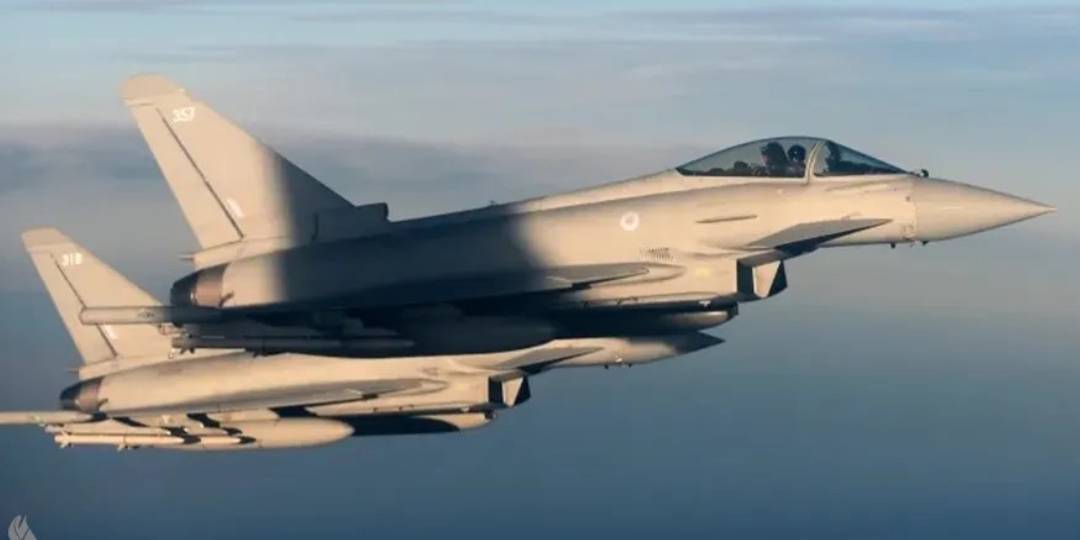

The United Kingdom Ministry of Defence announced on Tuesday that Royal Air Force Typhoon jets to protect Saudi cities will join integrated air defense operations following a wave of cross-border attacks targeting civilian infrastructure across the Kingdom. British military commanders confirmed that deployed combat aircraft will execute exclusively defensive interception and surveillance sorties without launching offensive strikes into Yemeni territory.
The military deployment responds to escalating Houthi drone and ballistic missile attacks that struck major Saudi urban centers and international airports in recent days, including an assault against King Khalid International Airport in Riyadh that caused civilian casualties. The decision underscores London’s enduring security commitment to one of its most significant Gulf partners while deliberately avoiding direct involvement in Yemen’s wider conflict theater.
British defense officials emphasized that the operational scope of the deployment limits RAF crews to radar surveillance, airspace monitoring, and aerial interception missions designed to shield non-combatants, passenger terminals, and strategic energy assets from incoming hostile projectiles.
Operational Scope of Typhoon Jets to Protect Saudi Cities
According to an official statement issued by the UK Ministry of Defence, deployed Typhoon squadrons will conduct continuous combat air patrols across designated airspace corridors, operating in close tactical coordination with Saudi air defense batteries and ground-based early warning radar installations.
Royal Air Force crews will leverage the Eurofighter Typhoon’s advanced multimode radar systems, high maneuverability at low altitude, and integrated electronic countermeasure suites. These capabilities allow rapid detection and neutralization of low-flying loitering munitions and drone swarms that frequently evade conventional radar tracking before reaching urban areas.
British officials stressed that the defensive mission parameters explicitly prohibit offensive operations against Houthi launch sites, reflecting London’s calculated approach to contain escalation while providing essential protective air cover for civilian populations.
Key Defensive Missions Assigned to RAF Squadrons
– Conducting round-the-clock air policing patrols to identify and intercept hostile drones and ballistic projectiles.
– Reinforcing early warning coverage and radar integration alongside Saudi surface-to-air defense networks.
– Safeguarding international airports, commercial ports, and energy infrastructure from aerial fragmentation damage.
– Providing technical intelligence sharing and tactical guidance to Saudi Air Force defense operators.
Escalating Threats Prompting the British Military Deployment
The British decision arrives after a series of escalating cross-border attacks attributed to Houthi forces launched from Yemeni territory. Recent strikes targeted the international airports serving Riyadh and Abha, resulting in fatalities and injuries among civilian travelers and residents, alongside structural damage to terminal facilities.
Military analysts observe that the Typhoon’s advanced sensor arrays provide a critical advantage against saturation drone tactics, which rely on launching multiple unmanned aircraft in sequential waves to overwhelm conventional air defense response networks before key assets sustain damage.
Enduring Pillars of the Saudi-British Defense Partnership
– Decades-long bilateral defense agreements, joint training programs, and coordinated military procurement frameworks.
– Reliance on Eurofighter Typhoon platforms as a core component of the Royal Saudi Air Force operational fleet.
– Shared expertise in electronic warfare, air defense integration, and combat aviation logistics.
– Diplomatic coordination to safeguard maritime security and commercial shipping routes through the Red Sea and Bab al-Mandab.
Strategic Implications for Gulf Regional Security
London’s announcement delivers a firm political and military signal of continued British commitment to Gulf security architecture. By reinforcing defensive coverage around critical Saudi facilities, the United Kingdom aims to protect energy supply chains and international aviation corridors that global markets depend upon.
The deployment also reflects a broader international effort to prevent further escalation across the Red Sea and Arabian Peninsula, preserving diplomatic channels while strengthening protective measures against asymmetric aerial threats targeting civilian populations and national infrastructure.
British defense authorities confirmed that additional operational details regarding squadron size, logistical basing arrangements, and deployment timelines will be announced in subsequent official briefings.
Conclusion:
The UK decision to deploy Typhoon jets to protect Saudi cities demonstrates a calculated balance between honoring long-standing defense commitments and avoiding direct military escalation inside Yemen. By reinforcing the protective umbrella over Saudi civilian infrastructure, London strengthens regional stability, safeguards global energy corridors, and enhances aerial security across the Arabian Peninsula.