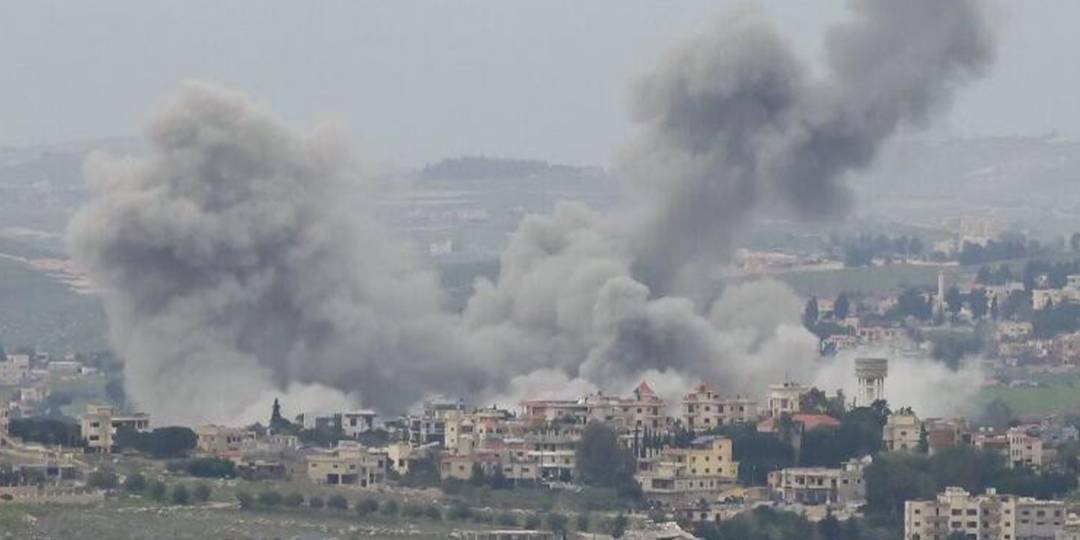

Intense military operations carried out by Israeli forces struck multiple towns, agricultural valleys, and residential districts across southern Lebanon on Sunday. The wave of airstrikes and shelling in southern Lebanon targeted locations across the Nabatieh, Tyre, Bint Jbeil, and Marjayoun districts, inflicting extensive structural damage on civilian homes, road networks, and rural infrastructure.
The continuous aerial bombardments coincided with concentrated artillery barrages, illumination flares, and controlled demolition operations within border villages. These escalations unfold against the backdrop of persistent obstacles impeding the phased implementation of the US-mediated framework agreement signed in June, which outlines a gradual deployment of the Lebanese Army alongside a full withdrawal of Israeli forces to enable post-conflict reconstruction and economic recovery.
Scope of Airstrikes and Shelling in Southern Lebanon Across Nabatieh and Strategic Valleys
Field correspondents reported that Israeli fighter aircraft carried out precision air raids hitting the municipal boundaries of Nabatieh al-Faouqa, Wadi al-Salouqi, Al-Qantara, and the forested area connecting Nabatieh al-Faouqa to Kfar Tebnit, alongside airstrikes on the coastal town of Al-Mansouri. The strikes sent thick plumes of smoke rising over residential sectors and disrupted essential transport links between southern municipalities.
Simultaneously, heavy artillery shelling struck the outskirts of Mayfadoun in the Nabatieh district, as well as the valleys of Zibqin, Al-Hujeir, and Al-Salouqi, the Khiam plains, and the perimeter of Hadatha, Hariss, Zawtar al-Sharqiya, Kfar Tebnit, and Baraachit. The sustained shelling ignited fires across agricultural orchards and hindered the movement of local emergency teams.
Municipalities and Valleys Hit by Airstrikes and Artillery
– Nabatieh District: Direct strikes targeting Nabatieh al-Faouqa, Kfar Tebnit, Zawtar al-Sharqiya, and Mayfadoun.
– Strategic Valleys and Plains: Heavy shelling across Wadi Zibqin, Wadi al-Hujeir, Wadi al-Salouqi, and the Khiam agricultural plains.
– Western and Central Sectors: Systematic attacks against Al-Mansouri, Al-Qantara, Hadatha, Hariss, and Baraachit.
– Illumination Flares: Deployment of nighttime illumination rounds over the airspace of Al-Mansouri and Kounine to monitor ground movements.
Systematic Demolitions and Infrastructure Destruction in Border Towns
Beyond aerial raids and artillery salvos, Israeli ground units executed extensive controlled demolition operations targeting residential homes and public buildings in the border towns of Beit Yahoun, Houla, Talloussa, Al-Mansouri, Aitaroun, and the outskirts of Baraachit, as well as inside Wadi Zibqin.
Local authorities indicate that these deliberate demolitions alter the geographical and urban landscape of frontier villages, preventing displaced families from returning safely to their homes. The operations deepen the humanitarian strain across southern governorates, while regular nighttime flare deployments illuminate sensitive areas along the border.
Humanitarian and Field Repercussions of Ground Operations
– Widespread destruction of residential neighborhoods across Beit Yahoun, Houla, Talloussa, and Aitaroun.
– Severe disruption to the safe return of displaced residents, compounding local socio-economic distress.
– Burning and fragmentation of farmland and olive groves caused by incendiary munitions and heavy ordnance.
– Informal establishment of buffer zones through the interdiction of civilian transport routes near the border.
Stalled Implementation of the Framework Security Agreement
The on-the-ground escalation coincides with procedural delays facing the implementation of the US-mediated framework agreement signed between Lebanon and Israel in June. The road map mandates specific security arrangements, including the gradual deployment of Lebanese Armed Forces personnel, the phased withdrawal of Israeli units, and international coordination for structural reconstruction and economic revival.
Officials in Beirut emphasize that daily strikes and demolition activities undermine stabilization efforts, preventing state security institutions from completing their operational deployment. Lebanese authorities continue to call on international mediators to press for a complete military withdrawal and an immediate halt to all cross-border attacks, enabling state authority to be fully restored.
Conclusion:
The persistence of airstrikes and shelling in southern Lebanon, coupled with large-scale demolitions, illustrates the volatile security landscape across the border. A complete cessation of hostilities and full compliance with security arrangements remain indispensable requirements for restoring regional stability, facilitating army deployments, and launching reconstruction across impacted southern communities.