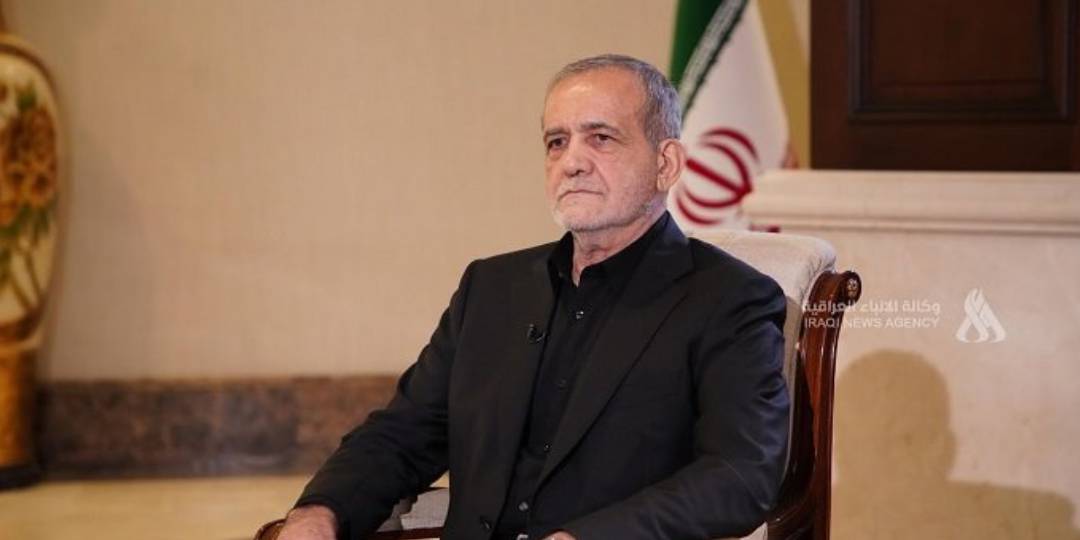

Iranian President Masoud Pezeshkian affirmed today Thursday that Iran “faces external pressure to increase economic pressure and destabilize internal stability and weaken national cohesion.” In parallel developments, Iran denied involvement in the explosion that struck a Korean vessel in the Strait of Hormuz, warning that non-compliance with its rules may lead to unintended incidents.
Developments reflect continuing tension between Iran and the United States over control of the Strait of Hormuz.
Pezeshkian affirms external pressure on Iran
Iranian President Masoud Pezeshkian stated in press remarks: “Iran faces external pressure to increase economic pressure, destabilize internal stability and weaken national cohesion.”
Pezeshkian added that “the enemy’s objective from pressure is creating general discontent and pushing people into streets and weakening governance structure.”
He said he “recently met with Supreme Leader Mojtaba Khamenei for two and a half hours in atmosphere based on trust and direct dialogue.”
Objectives of external pressure on Iran
The pressure targets:
Increasing economic pressure
Destabilizing internal situation
Weakening national cohesion
Creating general discontent
Explicit American statements about economic pressure
Pezeshkian pointed out that “American officials openly discuss tightening economic pressure on our people aimed at creating discontent.”
These American statements reflect clear and explicit policy toward weakening Iranian economy.
The Iranian statements came as response to continuing American economic pressure and sanctions.
American policy toward Iran
Includes:
Imposing severe economic sanctions
Tightening economic pressure
Attempting to create adverse social conditions
Weakening system from within
Meeting between Pezeshkian and Supreme Leader Khamenei
The Iranian president stated he “recently met with Supreme Leader Mojtaba Khamenei for two and a half hours.”
The meeting took place “in atmosphere based on trust and direct dialogue.”
This meeting reflects Iranian attempt to unify internal position facing external pressure.
Significance of Iranian internal coordination
The meeting indicates:
Attempt to unify internal position
Coordination between leadership and government
Direct dialogue and mutual trust
Preparation to confront pressure
Iran denies responsibility for Korean ship explosion
Iran denied Thursday “involvement of its armed forces in explosion that struck South Korean vessel in Strait of Hormuz.”
The explosion occurred aboard cargo vessel “HMM Maroo” flying Panamanian flag “Monday” with crew of “24 persons.”
US President Donald Trump later said Iran “fired some shots” at the vessel.
Details of Korean ship incident
The incident included:
Explosion aboard vessel
Subsequent fire
Crew of 24 persons
Vessel flying Panamanian flag
Iran’s official position on incident
Iran’s embassy in Seoul stated: “Tehran strongly rejects and categorically denies any claims related to involvement of Islamic Republic’s armed forces in incident that caused damage to Korean vessel.”
Iran confirmed it “bears no responsibility” for explosion that struck Korean ship.
Iran’s position came forcefully and clearly rejecting American accusations.
Iranian justification for position
Iran justified by:
Categorical denial of involvement
No action by its forces
Rejection of American accusations
Clarifying official Iranian position
Iran warns of unintended incidents in strait
Iran’s embassy clarified that “since United States and Israel launched strikes on Iran in late February, Tehran has repeatedly confirmed that Strait of Hormuz constitutes integral part of its defensive geography.”
It added that “safe passage through Strait of Hormuz requires full compliance with applicable rules.”
It warned that “any disregard for declared requirements and operational reality may lead to unintended incidents.”
Safe navigation conditions per Iranian position
Navigation requires:
Complete compliance with Iranian rules
Respect for Iran’s defensive geography
Commitment to declared requirements
Avoiding violation of defensive zone
Iran assigns responsibility for strait incidents
Iran’s embassy indicated that “responsibility for these consequences falls on parties proceeding with transport operations or activities in region without proper consideration of these factors.”
This Iranian statement clearly assigns responsibility to nations transiting the strait without respecting Iranian requirements.
Shared responsibility and international law
The issue relates to:
International maritime law
Rights of coastal states
Obligations of transiting vessels
Legal and moral responsibility
South Korea’s position on incident
South Korea said following American president’s statements that it would conduct “review of its position” regarding joining American operations in Strait of Hormuz.
However, National Security Advisor Wee Sung-lak said Wednesday that suspension of “Operation Inherent Resolve” made this “unnecessary.”
South Korea’s position reflected caution about engaging in US-Iran dispute.
Korean balancing act in Hormuz
South Korea attempts to:
Avoid full alignment with America
Maintain economic interests
Prevent direct confrontation with Iran
Preserve regional balance
Suspension of “Operation Inherent Resolve”
The United States announced suspension of “Operation Inherent Resolve” in Strait of Hormuz.
The suspension came following diplomatic pressure and regional developments.
Suspension reduced pressure on other nations to participate.
Context of US-Iran tension
The ship dispute comes within context of:
Continuing tension between America and Iran.
American attempts to impose control over Hormuz.
Iranian rejection of American control of strait.
Strategic importance of Strait of Hormuz
The strait represents:
High strategic importance globally
Vital passage for world trade
Sensitive area of Iranian influence
Location of geopolitical conflict
Contradictory Iranian and American discourse
The dispute reflects:
Contradiction in official narratives
Fundamental difference in interpretations
Competition over narrative and story
Competition for power and influence
Difficulty of independent verification
The media conflict creates:
Difficulty in independent verification
Reliance on biased sources
Absence of neutral observers
Difficulty accessing accurate information
International implications of dispute
The disagreement affects:
Regional security and stability
Global maritime trade
International relations balance
Oil market prices and stability
Need for international mediation
The situation requires:
Neutral international mediation
Fact-finding mechanisms
Diplomatic negotiation channels
De-escalation efforts
Conclusion:
Iranian president’s statements and Iran’s position on ship incident reflect continuing tension between Iran and United States. Iran’s firm position indicates Tehran’s desire to maintain control of Strait of Hormuz despite American pressure. The situation requires international efforts to de-escalate tensions and return to serious dialogue. Both sides’ contradictory accounts highlight challenges in achieving agreement on maritime safety and freedom of navigation in this strategically vital waterway.