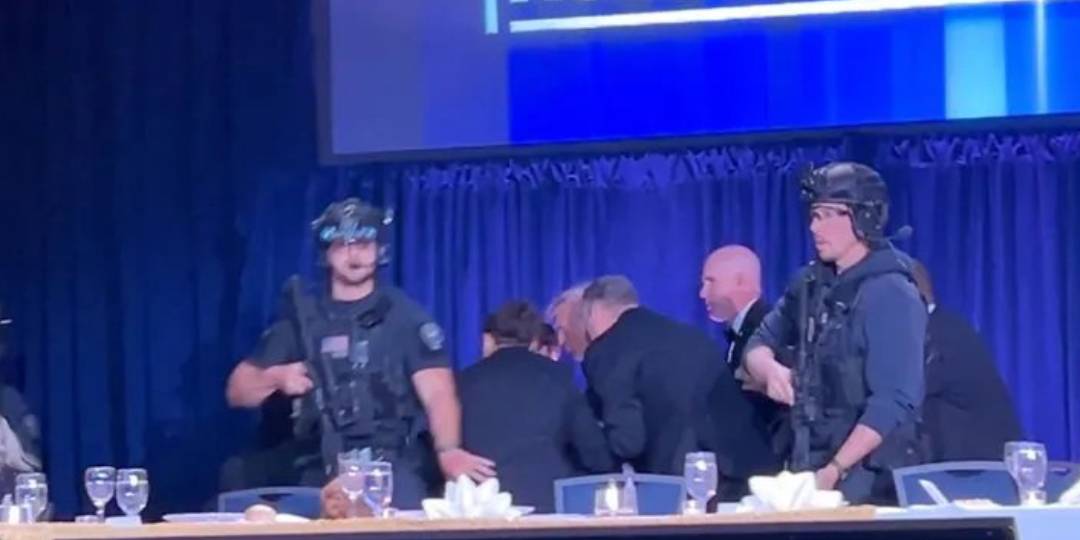

An armed assailant opened fire at the White House Correspondents Dinner at the Hilton hotel in Washington, D.C., during an event attended by President Donald Trump. The gunman breached a Secret Service checkpoint in the hotel lobby and initiated gunfire before being immediately apprehended by Secret Service personnel. The U.S. Department of Justice has filed two federal charges against the suspect, who will face arraignment Monday before federal court. The incident represents a serious security breach at a high-profile government event but was contained swiftly through professional security response protocols.
Secret Service personnel evacuated President Trump from the venue to safety, while attendees were directed to shelter during the incident. Preliminary investigations indicate the suspect acted alone without external support, though authorities continue investigating potential motives. President Trump characterized the suspect as a “lone wolf” and “mentally disturbed individual” following the incident.
Details of the Security Incident
The attack occurred during the annual White House Correspondents Dinner, an event bringing together the president and members of the media for formal dinner and remarks. The gunman breached perimeter security by forcing entry through a Secret Service checkpoint stationed in the hotel lobby.
Washington Police Department spokesperson stated: “We have no belief that the assailant was supported by any external organization. The attacker appears to have acted alone.” She added: “The suspect was unknown to city police, and preliminary information indicates he opened fire.”
Chronology of Events
The incident unfolded according to the following sequence:
- Attack Initiation: Gunman breaches checkpoint and opens fire
- Security Response: Immediate Secret Service intervention
- Suspect Apprehension: Gunman taken into custody by Secret Service personnel
- Presidential Evacuation: Trump transported to secure location
- Attendee Protection: Other dinner guests directed to shelter locations
- Scene Containment: Law enforcement secures the location
Suspect Profile and Weapons
Law enforcement released information regarding the suspect and weapons involved. Washington Police stated: “The suspect was armed with a hunting rifle, pistol, and several knives.”
Acting Attorney General Todd Blanche provided additional background: “The suspected shooter has no criminal record and was not under surveillance by law enforcement.” Blanche added: “He works as a teacher and video game developer.”
Suspect Background and Profile
Available information characterizes the suspect as follows:
- Employment: Teacher and video game developer
- Criminal History: No prior criminal record
- Law Enforcement Monitoring: Not previously monitored
- Mental Health Indication: Described by Trump as “mentally disturbed”
- Motives: Not yet fully determined by investigators
Suspect’s Confessed Targeting of Trump Administration Officials
CBS News reported critical information regarding the suspect’s statements. The network stated: “The suspect in the White House Correspondents Dinner shooting confessed to targeting officials in the Trump administration.”
The confession indicates deliberate targeting of specific individuals rather than random violence, elevating the severity of the alleged crime and suggesting premeditated intent to harm particular government officials.
Rapid Presidential Evacuation
Secret Service personnel executed evacuation procedures with professional efficiency. Axios reported: “The U.S. President was evacuated from the White House Correspondents Dinner by his security team.”
News reports indicated: “Secret Service personnel accompanied Trump out of the White House during dinner activities,” while video footage showed “Secret Service elements escorting Trump from the White House while attending the White House Correspondents Association dinner.”
Evacuation Procedures
Security response followed established protective protocols:
- Rapid Response: Immediate evacuation from venue
- Secure Transport: Safe conveyance to protected location
- Attendee Shelter: Direction of other attendees to protective positions
- Scene Control: Law enforcement containment of incident location
- Transparency: Communication with event attendees regarding situation
Federal Charges and Legal Proceedings
U.S. Department of Justice initiated criminal prosecution immediately. Acting Attorney General Todd Blanche announced: “Two federal charges have been filed against the suspect, and he will be arraigned Monday before federal court.”
The Swift prosecution demonstrates federal authorities’ serious response to the security breach and alleged violent act targeting government officials and a protected event.
Criminal Justice Process
Legal proceedings include the following elements:
- Charges Filed: Two federal charges
- Arraignment Date: Monday court appearance
- Prior Record: No previous criminal record documented
- Custody Status: Suspect in federal custody
- Investigation: Ongoing federal investigation into motives and circumstances
Role of Secret Service and Protective Operations
The Secret Service leadership emphasized effective response to the threat. The head of presidential protective operations stated: “The assailant was apprehended immediately upon attempting to approach the secure area.”
Washington D.C. Mayor clarified: “One armed individual breached a Secret Service checkpoint in the hotel lobby and was stopped by Secret Service personnel. We are excluding the possibility of additional conspirators in this incident.”
Exclusion of External Support or Conspiracy
Investigators ruled out external support for the attack. Police spokesperson stated: “We have no belief that the assailant was supported by any organization. The attacker appears to have acted alone.”
President Trump similarly rejected connections to external factors, stating: “I see no reason to believe the attack is connected to the war in Iran.”
President Trump’s Assessment of the Incident
Trump provided his personal characterization of the attacker and incident. Trump stated: “In my view, he was a lone wolf,” describing the man as “mentally disturbed.”
Trump added: “I feel no reason to believe the attack is connected to the war in Iran.” Trump characterized the suspect as a “potential killer,” noting possession of “multiple weapons.”
Trump’s Critique of Building Security
Trump made critical observations regarding venue security at a White House press conference: “The man breached a security checkpoint.” Trump noted: “One officer was shot but clearly survived due to wearing an excellent bulletproof vest.”
Trump continued: “We reviewed all circumstances that occurred, and I will say, as you know, it is not a particularly secure building.”
Implications for Future Events and Security Protocol
The incident raises significant questions regarding security at high-profile government events:
Security Review Implications:
- Assessment of protective protocols
- Identification of security vulnerabilities
- Protocol enhancement requirements
- Increased vigilance standards
Policy Implications:
- Media access versus security balance
- Future event security procedures
- Protective service protocols
- Governmental response frameworks
Ongoing Investigation and Information Gathering
Police spokesperson noted: “Motives for the suspect cannot currently be determined; details will be revealed after investigation completion.”
Federal investigators continue examining circumstances of the attack, statements by the suspect, and any potential organizational connections or ideological motivations.
Conclusion:
The armed attack on the White House Correspondents Dinner represents a serious security incident, yet swift and professional Secret Service response prevented catastrophic consequences and protected the President and attendees from harm. Preliminary investigations indicate the suspect acted alone without external organizational support, though full determination of motives awaits investigation completion and judicial proceedings.
The incident underscores the persistent security challenges facing high-profile government events requiring balance between democratic openness to media access and necessary protective security measures. While authorities deserve commendation for rapid and effective protective response, the breach of security checkpoints at a major presidential event will likely prompt comprehensive review of protective protocols and security procedures for similar future events.