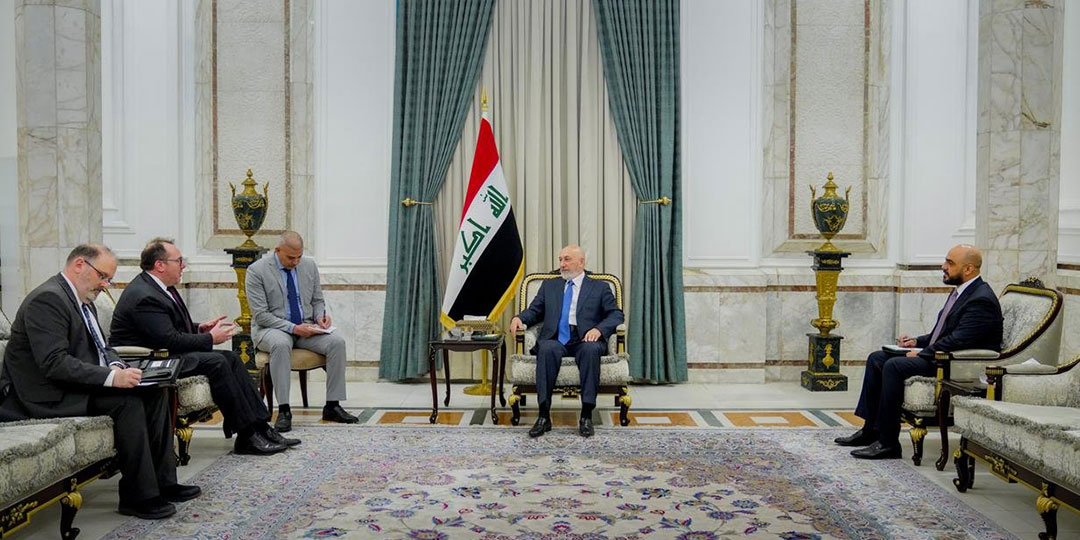

Iraq’s President Nizar Al-Amidi stressed the importance of de-escalation and dialogue as fundamental approaches to resolving regional crises on Tuesday, during an official reception of US Embassy Chargé d’Affaires Joshua Harris at Baghdad Palace. Al-Amidi stated that “emphasis was placed on the importance of de-escalation in the region, and adopting dialogue as a fundamental approach to addressing crises, contributing to achieving security and stability and establishing international peace.”
In parallel developments, Al-Amidi focused on critical economic issues in a separate meeting with Deputy Prime Minister and Oil Minister Hayan Abdul-Ghani, emphasizing that “conditions witnessed in the region directly reflect on the national economy,” requiring “greater planning and flexibility in resource management.” Al-Amidi commemorated the 38th anniversary of the Anfal campaigns, characterizing them as “among the most heinous crimes of genocide in modern history,” and called on federal and Kurdistan Region governments to “intensify efforts to search for remains of victims in mass graves and pursue comprehensive victim compensation and regional reconstruction.”
President Receives US Diplomat and Reiterates De-escalation Message
Al-Amidi received the American official with a clear policy message. The official statement noted that “President Nizar Al-Amidi received at Baghdad Palace Joshua Harris, Chargé d’Affaires of the United States Embassy in Iraq, who conveyed his country’s congratulations on Al-Amidi’s election as president.”
Al-Amidi expressed “appreciation for the kind congratulations,” emphasizing his “commitment to strengthening cooperation and friendship relations between the two countries in service of mutual interests and contributing to achieving stability and development.”
Bilateral Relations and Diplomatic Engagement
The formal reception of the US diplomat in Al-Amidi’s first official bilateral meeting underscores the importance Iraq places on maintaining robust US-Iraq cooperation and dialogue.
De-escalation and Dialogue as Fundamental Policy Approach
Al-Amidi presented a clear strategic vision. The statement confirmed that “emphasis was placed on the importance of de-escalation in the region, and adopting dialogue as a fundamental approach to addressing crises.”
The president added that this approach “contributes to achieving security and stability and establishing international peace,” signaling to the international community Iraq’s commitment to conflict mitigation rather than military escalation.
Iraq’s Regional Policy Framework
Al-Amidi’s statements reflect an official Iraqi policy prioritizing diplomatic solutions over military responses to regional tensions and conflicts.
Al-Amidi Addresses Oil Sector Challenges with Energy Minister
Al-Amidi focused on critical economic sectors. The statement indicated that “the president received Deputy Prime Minister and Oil Minister Hayan Abdul-Ghani, who presented congratulations on his assumption of the presidency.”
The meeting “reviewed the state of the oil industry and challenges it faces,” with the minister presenting “major current and future projects and the ministry’s plans for meeting domestic petroleum product demand.”
Oil Sector as Core Economic Foundation
Al-Amidi affirmed the “importance of advancing the oil sector as the fundamental pillar of the national economy,” reflecting clear understanding of petroleum’s centrality to Iraq’s economic stability and development prospects.
Regional Conditions Impact on National Economy
Al-Amidi articulated a direct causal relationship. He emphasized that “conditions witnessed in the region directly reflect on the national economy,” requiring government responsiveness to external shocks affecting oil prices and revenues.
This statement reflects sophisticated understanding of Iraq’s economic vulnerability to regional instability and geopolitical turbulence affecting global energy markets.
Economic Interdependence and External Vulnerabilities
Regional tensions directly affect Iraqi oil export revenues and economic stability, creating necessity for flexible economic policies capable of rapid adjustment to market fluctuations.
Planning and Resource Management Flexibility Required
Al-Amidi called for strategic adaptability. He stated that conditions “require greater planning and flexibility in resource management,” signaling that Iraq must develop economic policies capable of absorbing external shocks.
This approach reflects recognition that rigid economic policies cannot withstand volatile regional and global energy market conditions.
Strategic Economic Policy Adaptation
Managing Iraq’s resource-dependent economy in volatile regional conditions requires government capacity to adjust policies rapidly and implement flexible resource allocation mechanisms.
Commemoration of Anfal Campaigns: 38th Anniversary
Al-Amidi honored victims of historical atrocity. In an official statement, he noted that “on the 38th anniversary of the notorious Anfal campaigns implemented by the dictatorial regime in 1988, which claimed more than 182,000 children, women, and elderly from our people in Kurdistan, we commemorate with reverence the immortal martyrs and honor their steadfast families.”
The president characterized the Anfal as “among the most heinous crimes of genocide in modern history whose painful effects remain present in humanity’s conscience.”
Historical Significance and Collective Memory
The Anfal campaigns represent a foundational traumatic event in contemporary Iraqi history, shaping national identity and necessitating official commemoration and accountability mechanisms.
Recognition of Genocide and International Criminal Law
Al-Amidi emphasized legal and moral dimensions. He noted that “the Iraqi Supreme Criminal Court recognized the Anfal as a crime of genocide and crime against humanity,” providing legal framework for accountability and victim compensation.
This official recognition establishes legal basis for pursuing justice and demanding reparations for victims and their families.
Judicial Accountability and International Humanitarian Law
Legal recognition of Anfal as genocide establishes framework for criminal prosecution, victim compensation, and institutional accountability mechanisms essential to transitional justice processes.
Al-Amidi Calls for Victim Search and Remains Recovery
The president demanded comprehensive victim redress. He urged “federal and Kurdistan Region governments to intensify efforts to search for remains of victims in mass graves and return them to their families.”
Additionally, Al-Amidi called for “providing greater care to those injured and wounded from exposure to internationally prohibited weapons,” “compensating families for human and material losses suffered,” and “reconstructing affected areas.”
Transitional Justice and Victim Compensation
Comprehensive transitional justice requires integrated approaches encompassing victim remains recovery, medical care for survivors, family compensation, and physical reconstruction of damaged regions.
Care for Survivors and Affected Populations
Al-Amidi emphasized ongoing medical and social support. He called for “providing greater care to those injured and wounded from exposure to internationally prohibited weapons,” recognizing that survivor populations continue experiencing health complications decades after exposure.
This commitment reflects understanding that transitional justice encompasses long-term support for affected populations beyond criminal prosecution.
Long-term Victim Support and Health Services
Survivors of chemical weapons exposure and conflict trauma require sustained medical treatment, psychological counseling, and social support services extending beyond immediate post-conflict periods.
Compensation and Reparations for Families
Al-Amidi demanded material compensation. He insisted on “compensating families for human and material losses suffered,” recognizing that economic reparations constitute essential element of transitional justice and national reconciliation.
This commitment addresses tangible losses experienced by Anfal victims’ families requiring governmental restitution.
Economic Justice and Family Reparations
Providing financial compensation to victims’ families addresses economic dimensions of historical injustice and demonstrates governmental commitment to making reparations for systemic atrocities.
Reconstruction of Damaged Regions
Al-Amidi emphasized infrastructure rehabilitation. He called for “necessity of reconstructing affected areas, particularly following the Supreme Criminal Court’s recognition of Anfal as genocide and crime against humanity.”
This commitment addresses physical devastation from conflict and demonstrates governmental commitment to restoring affected communities’ economic and social infrastructure.
Regional Development and Post-Conflict Reconstruction
Reconstructing regions affected by conflict represents essential element of transitional justice, enabling economic recovery and rebuilding of community institutions damaged during historical atrocities.
Promoting National Unity and Democratic Governance
Al-Amidi emphasized forward-looking reconciliation. He stressed “the importance of promoting unity and solidarity among components of the Iraqi people, preserving achieved gains, and protecting the democratic system to achieve a better future characterized by justice, peace, and prosperity.”
This statement represents conscious attempt to transform historical trauma into foundation for national cohesion and democratic development.
Reconciliation and Democratic Consolidation
Commemorating historical atrocities while promoting national unity represents delicate balance between acknowledging historical injustice and building inclusive democratic future transcending sectarian divisions.
Comprehensive Policy Vision
Al-Amidi’s statements reflect integrated approach addressing simultaneous imperatives of regional diplomacy, economic management, and historical justice accountability. The three separate meetings (US diplomat, oil minister, and commemorative statement) represent parallel policy tracks addressing interconnected challenges.
Multidimensional Governance Strategy
The president’s approach demonstrates recognition that effective governance requires simultaneous attention to diplomatic relations, economic resilience, and transitional justice processes essential to national cohesion.
Regional Context and International Implications
Al-Amidi’s emphasis on de-escalation and dialogue reflects Iraq’s interest in regional stability affecting oil markets and economic performance. Commemorating Anfal and demanding victim compensation reflects Iraq’s commitment to justice accountability and post-conflict reconciliation essential to democratic legitimacy.
Conclusion:
President Nizar Al-Amidi’s statements demonstrate comprehensive policy vision integrating diplomatic engagement, economic management, and transitional justice priorities. His emphasis on de-escalation and dialogue signals Iraqi commitment to peaceful conflict resolution and regional stability. The focus on oil sector challenges and economic flexibility reflects sophisticated understanding of Iraq’s vulnerability to regional disruptions affecting petroleum revenues and development prospects. Commemoration of the Anfal and demands for victim compensation, survivor support, and affected region reconstruction demonstrate governmental commitment to historical accountability and national reconciliation essential to democratic consolidation. The convergence of these policy initiatives suggests Al-Amidi seeks to position Iraq as stability anchor within volatile regional environment while advancing transitional justice and economic resilience simultaneously. The substantive translation of these policy statements into effective governmental action will test Iraq’s institutional capacity to address these complex, interconnected challenges.