The Munich Security Conference 2026 opened amid visible strains between Europe and the United States, with European leaders urging a reset in transatlantic relations. The annual gathering in southern Germany brought together more than 60 heads of state and government and around 100 foreign and defence ministers under heightened security.
German Chancellor Friedrich Merz and French President Emmanuel Macron used the forum to call for a stronger and more autonomous Europe, while maintaining NATO as the cornerstone of collective defence.
The conference comes as Russia’s war against Ukraine approaches its fifth year and as US President Donald Trump’s rhetoric toward European allies has intensified tensions within the alliance.
Merz Calls for “New Transatlantic Partnership”
Opening the Munich Security Conference 2026, Merz acknowledged what he described as a “deep divide” between Europe and the United States.
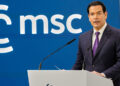
“Let’s repair and revive transatlantic trust together,” he said, addressing US Secretary of State Marco Rubio and other senior officials present.
Merz stressed that NATO remains mutually beneficial. “Being part of NATO is not only Europe’s competitive advantage. It is also the United States’ competitive advantage,” he said.
He warned that in an era of great power rivalry, Washington would not be able to act alone. At the same time, he underlined that Europe must increase defence spending and assume greater responsibility for its own security.
According to a German government source, Merz met Rubio on the sidelines to discuss:
The status of negotiations related to the Ukraine war
Continued military aid to Kyiv
NATO’s future role
Tensions involving Iran
The source added that Rubio praised Germany’s recent steps to strengthen the alliance.
Macron Defends Europe’s Role
“A Strong Europe in a Strong NATO”
French President Emmanuel Macron defended Europe against what he described as external criticism. Speaking at the conference, he said Europe should be viewed as a model rather than a target of attacks.
Macron argued that Europe must become a geopolitical power capable of shaping its own security architecture. He expressed support for US efforts toward a negotiated settlement in Ukraine, while warning that any post war framework must address what he called “an aggressive Russia.”
“This Europe will be a good ally and partner for the United States,” Macron said, adding that Europe must take its fair share of defence responsibilities.
British Prime Minister Keir Starmer was expected to tell the conference that Europe is “a sleeping giant” and should rely less on Washington for its defence, according to his office.
Trump’s Greenland Annexation Threat and NATO Tensions
The Munich Security Conference 2026 is taking place against a backdrop of heightened friction following Trump’s threats last month to annex Greenland, an autonomous territory of NATO member Denmark.
European governments strongly opposed the proposal, describing it as unacceptable. Denmark’s Prime Minister Mette Frederiksen later described talks with Rubio as “constructive,” after a brief meeting involving Danish and Greenlandic officials.
Transatlantic tensions have also been fuelled by:
Trump’s criticism of European defence spending
Accusations of “civilisational decline” in US strategic documents
Disagreements over trade and tariffs
Rubio, seen by some diplomats as a more conciliatory figure, was scheduled to address the conference on Saturday in an effort to reassure European allies.
Ukraine War Dominates Agenda
Zelensky Meets European Leaders
Russia’s war against Ukraine remains central to discussions at the Munich Security Conference 2026. Ukrainian President Volodymyr Zelensky met Merz, Macron, EU officials, Canadian representatives and NATO Secretary General Mark Rutte.
Zelensky also visited a drone production facility near Munich with German Defence Minister Boris Pistorius before holding high level talks.
At the White House, Trump urged Zelensky to accelerate efforts to reach a deal with Moscow, stating that Russia wanted to negotiate. However, Merz said Moscow was “not yet willing to talk seriously.”
No Russian officials were invited to the conference.
Chinese Foreign Minister Wang Yi also met Rubio and Ukrainian Foreign Minister Andriy Sybiga on the sidelines. According to China’s state news agency Xinhua, Beijing expressed willingness to provide additional humanitarian aid to Ukraine.
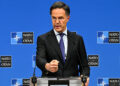
NATO chief Mark Rutte said Europe was “stepping up” and assuming a larger leadership role within the alliance. “A strong Europe in a strong NATO means that the transatlantic bond will be stronger than ever,” he said.
Conclusion:
As global tensions intensify, the Munich Security Conference 2026 has underscored Europe’s determination to strengthen its defence capabilities while preserving strategic ties with Washington. Whether calls for a reset will translate into policy changes remains uncertain, but European leaders signalled a clear intention to assert greater autonomy within the NATO framework.