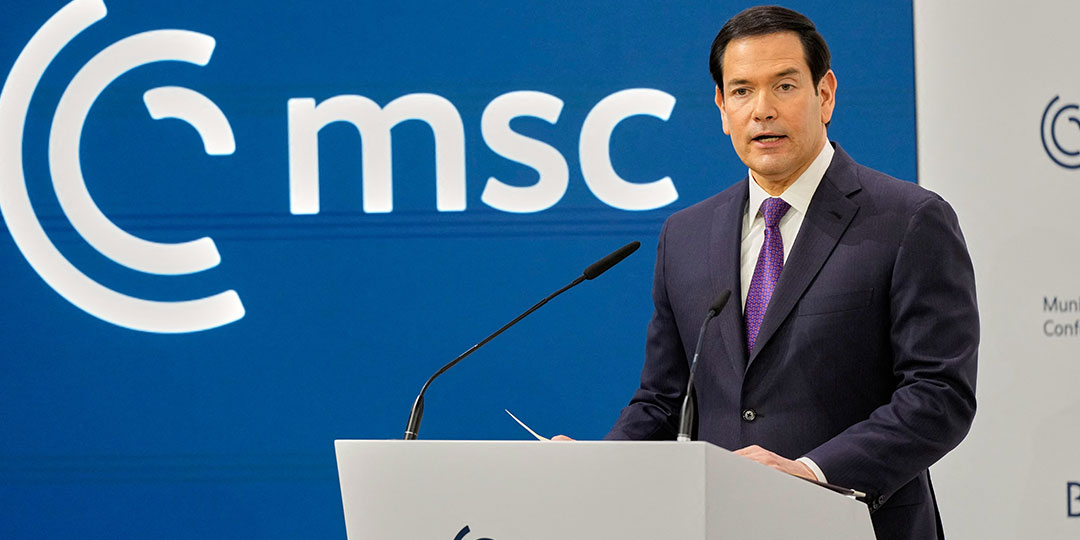

The Marco Rubio Munich speech at the 2026 Munich Security Conference received a cautious but generally positive response from European officials, who welcomed his conciliatory tone while underlining that significant policy differences remain.
Speaking before heads of state, foreign ministers and defence chiefs in Germany, the US Secretary of State emphasised shared history and values between the United States and Europe, declaring that the two sides “belong” together.
His address came amid recent tensions over US foreign policy positions, including President Donald Trump’s stated ambition to seize Greenland, an autonomous territory of Denmark, which is a member of both the European Union and NATO.
Emphasis on shared history and alliance renewal
Rubio told delegates that “the fate of Europe will never be irrelevant to our own,” adding that the destinies of the United States and Europe are “intertwined.” He stressed that Washington does not seek separation from Europe but aims to “revitalise” the transatlantic alliance.
“We do not seek to separate, but to revitalise an old friendship,” Rubio said, calling for what he described as a renewed and reinvigorated partnership.
The speech was closely watched, particularly after US Vice President JD Vance used the same platform last year to criticise European immigration policies and accuse some governments of restricting free speech.
German Foreign Minister Johann Wadephul said it was positive that Rubio focused on past achievements and future cooperation.
“He was looking forward. This is good,” Wadephul said, adding that the relationship could once again become a “success story.”
For Estonia’s Defence Minister Hanno Pevkur, the address offered reassurance. He told AFP that the speech showed the United States and Europe “are still allies and partners.”
Key differences remain over migration and global institutions
Despite the warmer tone, Rubio did not avoid contentious issues. He criticised what he described as mass migration to Western countries and warned of de industrialisation. He also called for global “renewal” under the leadership of President Trump.
Among the most notable points of the Marco Rubio Munich speech was his criticism of the United Nations. He said the organisation had played “virtually no role” in resolving major conflicts and lacked answers to urgent global crises.
“It could not solve the war in Gaza,” Rubio stated, while adding that the UN still has “tremendous potential” if reformed.
German Foreign Minister Wadephul responded by emphasising the importance of maintaining an international rules based order. Referring to the United Nations as “our Board of Peace,” he signalled that Berlin continues to view the UN as central to global conflict resolution.
The remarks come as President Trump has established a new conflict resolution body, a move some observers interpret as an attempt to rival the UN’s traditional role.
European reactions at a glance
European officials expressed a mix of relief and caution:
Germany welcomed the forward looking tone but cited “uncertainties” in the relationship.
France stressed the need for a strong and independent Europe regardless of speeches in Munich.
Estonia described the speech as reassurance that the alliance remains intact.
Lithuania’s former foreign minister criticised the address as a stylistic change rather than a policy shift.
Gabrielius Landsbergis, Lithuania’s former top diplomat, wrote on X that Rubio’s remarks were delivered in “more polite terms” but did not represent a departure from US policy. He suggested the speech attempted to cover “cracks” in transatlantic ties.
Strategic recalibration and broader context
The speech also took place against a backdrop of shifting global alliances. Wadephul noted that “for Germany and for Europe, it’s absolutely clear we need new global partners.”
He made the comments while appearing alongside India’s foreign minister, following the European Union’s recent major trade agreement with India.
French Foreign Minister Jean Noel Barrot said Rubio’s reference to shared democratic history was generally well received. However, he underscored that Paris remains focused on building “a strong and independent Europe,” regardless of rhetoric from Washington.
Why it matters
The debate highlights ongoing questions about the future of US Europe relations under the current US administration.
Key issues shaping the relationship include:
Migration policies and domestic political pressures in Europe and the US.
The role of multilateral institutions such as the United Nations.
Territorial and sovereignty concerns, including US ambitions regarding Greenland.
Europe’s efforts to strengthen strategic autonomy and diversify partnerships.
While Rubio’s tone marked a shift from last year’s confrontational rhetoric, European officials signalled that rebuilding trust will depend on concrete policy actions rather than speeches alone.
Conclusion:
The Marco Rubio Munich speech eased immediate tensions at the Munich Security Conference, but European leaders made clear that differences over migration, global governance and strategic direction remain unresolved. The future of the transatlantic alliance will likely depend on how these issues are addressed in practice.