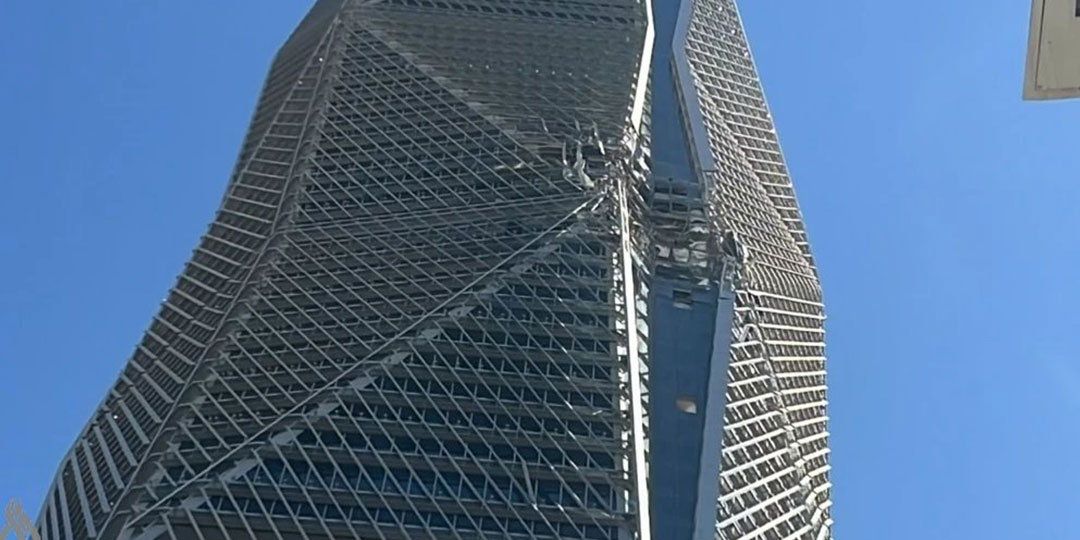

Security and defense authorities in the Kingdom of Saudi Arabia announced on Thursday, November 19, 2026, that a major economic landmark in the capital sustained physical damage following a new aerial assault. The Saudi Civil Defense confirmed that the recent targeting Riyadh Financial Center resulted in a direct impact on one of the towers within the “King Abdullah Financial District” (KAFD). This occurred after emergency sirens were activated across various neighborhoods in the city to warn residents of imminent aerial threats executed by the Houthi group (Ansar Allah).
This escalation in the capital coincided with a wave of intensive attacks directed at the southern regions of the Kingdom. The Command of the Coalition to Restore Legitimacy in Yemen announced that its air defense systems successfully intercepted and destroyed six diverse missiles, including ballistic and cruise variants. Major General Turki Al-Maliki, the official spokesperson for the Coalition forces, confirmed that air and artillery units launched an immediate response that resulted in the destruction of the launch pad used in the Riyadh attack, which was identified within the Yemeni city of Dhamar.
Operational Details of Targeting Riyadh Financial Center and Structural Damage
Saudi Civil Defense reports indicated that field teams arrived at the site immediately following the explosion, where it was found that glass facades and structural sections of one of the towers within the financial hub were damaged. As the primary heart of business and investment in the Saudi capital, the strike represents an escalation affecting vital economic infrastructure. The official statement confirmed that standard precautionary measures for such incidents were implemented to ensure the safety of employees within the district and the surrounding buildings.
Media sources monitored by the Iraqi News Agency (INA) noted that the attack caused significant concern within the commercial community. However, authorities emphasized that the situation was quickly contained, and no major human casualties were reported within the targeted location. This incident is part of a series of repeated attempts to strike deep into Saudi territory, which observers place within the context of military and political pressure exerted by the Houthi group amidst the ongoing regional conflict.
Air Defenses Intercept Cruise and Ballistic Missiles in the South
On the air defense front, the past few hours witnessed exceptional military activity by Saudi interception systems, which neutralized coordinated attacks targeting cities in the Southern region. Major General Turki Al-Maliki stated that Coalition forces succeeded in destroying four ballistic missiles at once that were directed toward populated residential areas. This was in addition to the interception of a “Cruise” type loitering missile and another ballistic missile shot down in the early hours of the morning.
Al-Maliki stressed that these attacks reflect a systematic hostile approach targeting civilians and civilian facilities. He affirmed that the air defenses possess full readiness to deal with various types of projectiles, whether they are long-range ballistic missiles or cruise missiles that fly at low altitudes to evade traditional radar detection.
Outcomes of Defensive Operations in the Last 24 Hours:
* Interception of 4 Ballistic Missiles: These targeted the Southern region and were destroyed before reaching their intended coordinates.
* Destruction of a “Cruise” Missile: A high-precision land-attack cruise missile was neutralized in the air over the southern sector.
* Neutralizing the Riyadh Threat: Handling the missile threat that led to the damage of the financial tower and the activation of emergency sirens.
* Destruction of a Dawn Missile: Intercepting a ballistic missile in the early morning hours before it could enter urban airspace.
Coalition Retaliation and Destruction of the Launch Pad in Dhamar
Within the framework of the right to respond and defend sovereignty, the Coalition Command announced a precise military operation targeting the interior of Yemen. The official spokesperson explained that warplanes monitored and destroyed a ballistic missile launch pad in the city of Dhamar. He noted that intelligence information confirmed that this specific platform was used in the attempted attack that targeted the Saudi capital, Riyadh, earlier today.
The statement mentioned that destroying the platform aims to paralyze the group’s capabilities to execute cross-border attacks and protect Saudi cities from random projectiles. This operation confirms the continued policy of “active deterrence” pursued by the Coalition, which is based on pursuing fire sources, weapon depots, and Houthi ammunition stores to reduce security risks to air navigation and national facilities.
Impact of Escalation on Energy Security and Regional Stability
The targeting Riyadh Financial Center and other vital sites raise international concerns regarding the stability of global markets and the security of maritime corridors in the region. As the capital, Riyadh serves as a regional hub for international energy and finance companies, and any threat to its security reflects directly on insurance costs and geopolitical risks in the Middle East.
Security experts believe that the focus on using advanced “Cruise” missiles in recent attacks indicates the group’s acquisition of sophisticated military technologies aimed at creating a breach in the defensive umbrella. This requires broader international coordination to prevent the flow of such weapons and to protect civilian objects shielded under international law.
Conclusion
The targeting Riyadh Financial Center and the missile attacks on the southern region represent a new chapter of military tension in the Arabian Peninsula. While Saudi air defenses continue to prove their efficiency in intercepting missiles and destroying launch pads, there remains an urgent need for comprehensive political solutions to end cross-border threats. Ensuring the safety of civilians and economic facilities, which are the backbone of stability in the region and the world, remains the ultimate priority for the international community.