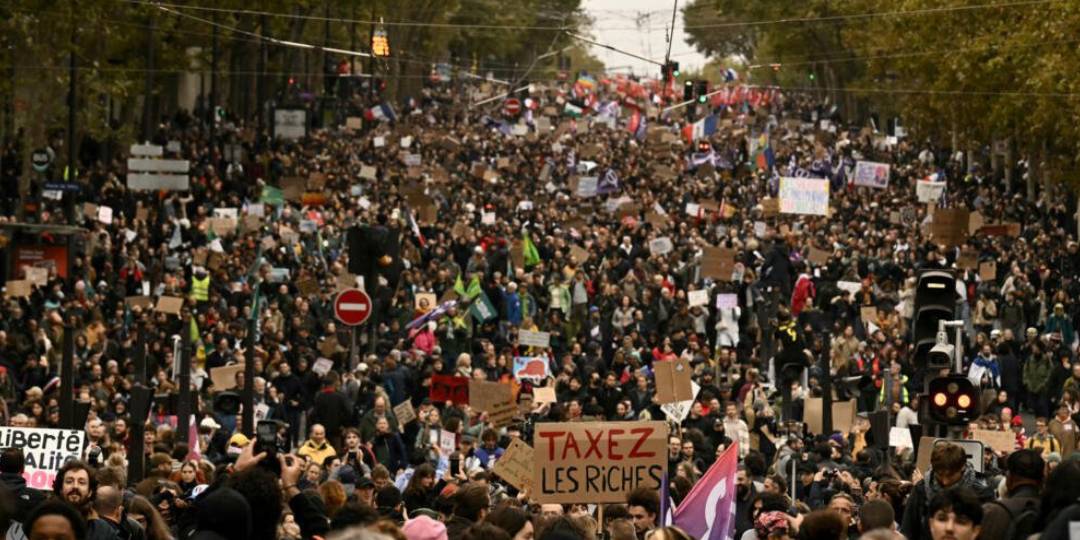

A coordinated wave of social and labor discontent swept across Western Europe over the weekend, as escalating cost of living protests in Europe brought hundreds of thousands of demonstrators into the streets of major French and Italian cities. The demonstrations highlighted public anger over declining household purchasing power, high inflation, and the continuous diversion of state funds toward military spending.
In France, the Ministry of the Interior announced on Sunday, October 25, 2026, that law enforcement officers detained 1,314 individuals across the country following clashes during weekend marches. The ministry added that 53 police officers sustained injuries while attempting to disperse combative groups and contain property damage in commercial districts.
Concurrently, large-scale rallies unfolded across major Italian metropolitan centers, where demonstrators protested against foreign armed conflicts and soaring domestic prices. Italian authorities deployed heavy security cordons around retail corridors to prevent a recurrence of the vandalism that hit businesses the previous week, reflecting an interconnected crisis of economic strain and political frustration across the continent.
Mass Detentions Across France as Cost of Living Protests in Europe Escalate
Reporting by Agence France-Presse confirmed that France experienced its second consecutive weekend of severe civil unrest. Demonstrations organized by labor federations, student groups, and Yellow Vest committees drew massive crowds in Paris, Lyon, and Marseille, with participants demanding immediate wage adjustments and statutory caps on consumer energy bills.
The French Interior Ministry stated that tactical security units intervened firmly against groups accused of property destruction, looting, and assaults on police personnel. Out of the 1,314 people taken into custody, hundreds were held for formal judicial investigation, while hospitals provided medical care to 53 injured police officers and gendarmes.
The scale of the police response underscores the growing difficulty in containing public frustration. Protesters argue that the government has failed to protect working families from high food costs and utility bills, while underfunding essential public services such as education, regional clinics, and municipal transport.
Key Operational Figures from the French Demonstrations
– National law enforcement carried out 1,314 custodial arrests across urban centers.
– The Interior Ministry confirmed injuries to 53 police officers during street confrontations.
– The weekend marked the second consecutive cycle of nationwide unrest over living standards.
– Static security cordons were reinforced around commercial hubs in Paris, Lyon, and Marseille.
Italian Demonstrations Challenge Inflation and Defense Budgets
Across the border in Italy, Reuters reported widespread public demonstrations across primary urban centers, including Rome, Milan, and Naples. Protesters carried banners condemning the erosion of real wages while calling for an immediate end to international military entanglements and defense spending increases.
Italian security agencies deployed riot police units and established safety perimeters around commercial zones and municipal buildings. The deployment aimed to avert the looting and storefront destruction recorded during protests earlier in the month, keeping march routes away from vulnerable retail sectors.
The Italian demonstrations highlighted the link between international geopolitical crises and everyday domestic hardship. Labor unions and civic organizations argued that public budgets should prioritize energy subsidies, affordable housing programs, and healthcare resources rather than foreign defense assistance.
Primary Demands Advanced by Italian Protesters
– Reallocating public funds from military assistance toward domestic social safety nets.
– Introducing legislative caps on residential electricity tariffs and natural gas prices.
– Protecting middle and lower-income households from continuing grocery price inflation.
– Preserving the right to peaceful assembly while shielding downtown retail districts from unrest.
Structural Economic Pressures Facing the European Union
The weekend demonstrations across France and Italy illustrate that economic discontent is spreading across national boundaries. Prolonged spikes in consumer energy costs, combined with persistent food inflation and tighter monetary policy, have constrained disposable income for millions of European families.
Labor economists observe that relying on police intervention and mass arrests will not resolve the underlying economic issues. With major labor confederations across the continent coordinating general strikes and transport walkouts for November, European governments face intense pressure to introduce real fiscal measures that ease the burden on households.
Without targeted relief programs and structured dialogue with trade unions, the combination of high living expenses and public spending disputes risks triggering wider civil unrest in the coming months.
Conclusion:
The detention of more than 1,300 people in France alongside widespread marches in Italy shows that cost of living protests in Europe have entered a serious phase. As working-class communities demand lower prices and better public services, European leaders must balance public order with meaningful economic relief to prevent prolonged instability across the continent.