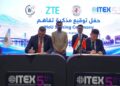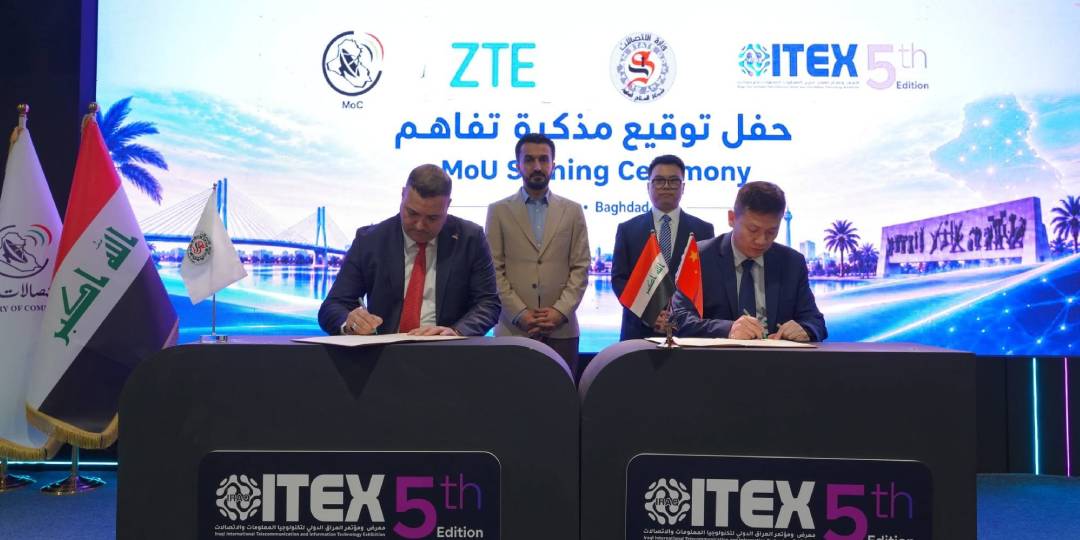

Iraq’s Ministry of Communications announced the signing of a landmark MoU with China’s ZTE through its subsidiary, Al-Salam General Company, to expand bilateral technology partnerships and establish domestic manufacturing capabilities. The signing ceremony took place during the closing events of the ITEX 2026 International Information Technology and Communications Exhibition and Conference held at the Baghdad International Fairground.
Minister of Communications Mustafa Sanad sponsored the memorandum as part of a national strategy to localize advanced industrial knowledge, strengthen relations with global technology leaders, and build modern digital infrastructure. The exhibition’s closing sessions also featured wide acclaim from government, banking, and financial institutions, which highlighted the event’s role in accelerating digital transformation, expanding financial literacy, and forging cross-sector cooperation.
Strategic Scope of the MoU with China’s ZTE
According to an official statement released by the Ministry of Communications, the memorandum signed between Al-Salam General Company and ZTE establishes a comprehensive framework for joint industrial and technological development. The agreement focuses on introducing modern assembly lines, advanced telecommunications hardware, and production know-how into Iraqi state enterprises.
The ministry emphasized that the partnership reflects a deliberate policy shift from importing finished equipment toward domestic production. By leveraging ZTE’s global expertise, Iraq aims to develop national capability in network engineering, enterprise ICT solutions, and hardware manufacturing while training local engineers to manage next-generation systems.
Core Objectives of the Technology Transfer Partnership
– Establishing localized manufacturing capacity for telecommunications equipment within Al-Salam General Company facilities.
– Modernizing national telecom networks in line with international broadband and enterprise connectivity standards.
– Training Iraqi engineering cadres on advanced production management, diagnostics, and smart network operations.
– Supplying ministries and public institutions with reliable, locally supported ICT hardware and software platforms.
Banking, Financial, and Government Sectors Endorse ITEX 2026
The closing sessions of ITEX 2026 featured strong praise from participating financial institutions. Ghafran Nabil of the Iraqi National Bank told the Iraqi News Agency that the exhibition enabled direct engagement with innovative local and international firms, allowing the bank to present digital lending, account services, and online banking applications to visiting citizens.
Representatives of the Iraq Securities Commission echoed similar enthusiasm. Hassan Ahmed from the Commission’s Financial Disclosure Department highlighted that the exhibition helped popularize stock market trading culture among younger demographics, noting that several participating companies initiated contact regarding potential listing procedures, a step expected to broaden Iraq’s securities market.
Key Gains for Financial and Institutional Participants
– Digital Banking Expansion: Direct consumer education on mobile applications, electronic payments, and personal financing tools.
– Capital Market Growth: Attracting new corporate listings to strengthen Iraq’s securities exchange and diversify investor channels.
– Education Digitization: Showcasing electronic platforms that modernize student registration, school administration, and public services.
– Institutional Partnerships: Facilitating cooperation agreements between ministries, Arab companies, and international technology providers.
Education Sector Accelerates E-Government Adoption
Speaking during the exhibition, Engineer Nizar Mohammed Saeed, Director of the Information and Communications Center at Iraq’s Ministry of Education, confirmed that the ministry’s participation aligns with national directives to digitize administrative and academic workflows.
Saeed noted that the event provided practical exposure to emerging technologies suitable for real-world application, allowing education officials to hold direct coordination meetings with regional and international technology companies regarding smart classroom solutions, student data systems, and electronic service delivery.
Conclusion:
ITEX 2026 concluded on a high note, demonstrating Iraq’s growing capacity to attract global technology partnerships. The MoU with China’s ZTE marks a decisive pivot toward domestic manufacturing and knowledge localization, complemented by banking, financial, and educational institutions advancing Iraq’s transition toward a fully integrated digital economy.