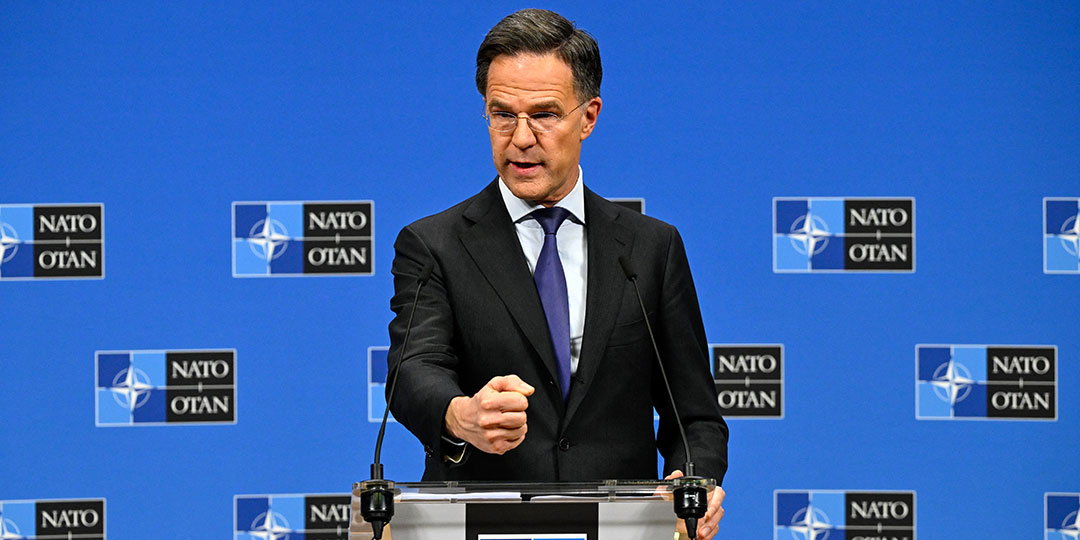

The NATO Nuclear Umbrella remains the cornerstone of Europe’s security, according to Secretary General Mark Rutte, who said no European country is seeking to replace the United States’ nuclear protection.
Speaking at the Munich Security Conference on Saturday, Rutte stressed that discussions about strengthening European nuclear deterrence are meant to reinforce existing arrangements, not substitute Washington’s role.
His remarks came amid growing debate among European leaders over how to respond to Russia’s military posture and questions surrounding long term US security commitments under President Donald Trump.
Rutte: US Nuclear Deterrence Is the “Ultimate Guarantor”
Mark Rutte told journalists in Munich that while European countries may examine ways to strengthen collective deterrence, “nobody is arguing in Europe to do this as a sort of replacement of the nuclear umbrella of the United States.”
He described the US guarantee as the “ultimate guarantor” of European security, adding that any additional European initiatives would complement, not replace, the American role within NATO.
Officials from the Trump administration have urged European allies to assume greater responsibility for conventional defence spending. At the same time, US officials have reiterated that Washington will continue to provide nuclear protection to NATO members.
Within NATO’s framework, nuclear deterrence already operates under established plans, capabilities and doctrines. Estonian Foreign Minister Margus Tsahkna told AFP that the current system “is working,” emphasizing that Europe already benefits from a structured deterrence policy.
Germany, France and UK Deepen Nuclear Talks
The renewed focus on the NATO Nuclear Umbrella coincides with statements from key European leaders about expanding cooperation.
German Chancellor Friedrich Merz revealed that he had held confidential talks with French President Emmanuel Macron regarding European nuclear deterrence.
British Prime Minister Keir Starmer also announced that the United Kingdom is enhancing nuclear cooperation with France. Britain and France are currently Europe’s only nuclear armed powers.
Starmer stated that any adversary should understand that in a crisis they could face the combined strength of both countries. The UK’s nuclear deterrent already contributes to NATO’s overall protection framework.
However, analysts note a significant gap in capabilities:
The United States and Russia each possess thousands of nuclear warheads.
• France and the United Kingdom together maintain arsenals numbering in the hundreds.
This imbalance means that, in the short term, most experts consider it unrealistic for Europe to fully replace US nuclear deterrence.
Europe’s Nuclear Options Under Review
A report presented at the Munich Security Conference assessed “Europe’s nuclear options” and warned that there is no low cost or risk free solution to Europe’s current security dilemma.
The report identified five possible approaches:
Continue relying on American nuclear deterrence.
Strengthen the role of British and French nuclear forces within a broader European framework.
Jointly develop European nuclear weapons.
Increase the number of European countries with their own nuclear arsenals.
Expand conventional military power to enhance non nuclear deterrence.
According to the authors, maintaining reliance on the United States remains the most credible and feasible option in the near term.
The report also stressed that Europe can no longer avoid serious debate about nuclear strategy, especially in light of what it described as Russia’s nuclear backed policies and the ongoing war in Ukraine. Several European officials believe Moscow’s territorial ambitions may not stop at Ukraine, raising concerns even among NATO member states.
Macron’s Upcoming Nuclear Doctrine Speech
French President Emmanuel Macron, who has previously suggested extending France’s nuclear protection to European partners, is expected to deliver a major speech on French nuclear doctrine later this month.
Macron indicated in Munich that his vision could include special cooperation arrangements, joint exercises and shared security interests with selected countries.
Experts say the speech could clarify whether France is prepared to broaden its nuclear role within Europe, although practical challenges remain. These include financial costs, operational command authority and, in the case of the UK, reliance on US technology for parts of its nuclear system.
Conclusion:
Despite intensifying debate over European nuclear capabilities, NATO leaders have made clear that the NATO Nuclear Umbrella provided by the United States remains central to Europe’s defence. While France, Germany and the United Kingdom explore closer cooperation, no European government has formally proposed replacing the American deterrent.