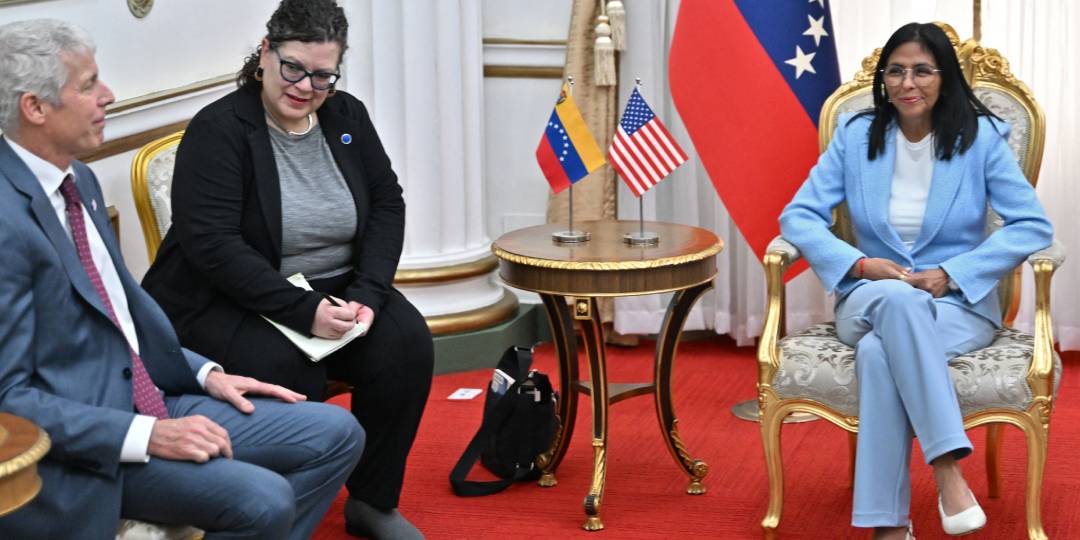

The Venezuela amnesty law moved a step forward on Saturday after 17 political prisoners were released from a detention center in Caracas, even as parliament continues debating the final approval of the legislation.
National Assembly President Jorge Rodriguez announced that the detainees were freed from the Zona 7 facility in the capital, describing the move as part of efforts to advance what he called “democratic coexistence.”
The proposed law is expected to cover charges brought over nearly three decades against opponents of former president Nicolas Maduro and his predecessor Hugo Chavez. The debate comes amid major political changes following Maduro’s arrest by US special forces in early January.
17 detainees released before final vote
Rodriguez said on social media that “17 people deprived of their liberty in Zona 7 are being released at this moment,” referring to the Caracas detention center. He did not disclose the names of those freed.
Lawmakers postponed a final vote on the amnesty bill on Thursday after failing to agree on how it should be implemented. Parliamentary debate is set to resume on February 19.
According to the draft text, the law would nullify charges such as:
“Treason”
• “Terrorism”
• “Incitement to hate”
These accusations were widely used over the years to prosecute and imprison political opponents, activists and critics of the government.
The proposed legislation has already passed a first reading in the National Assembly. However, disagreements emerged over a provision requiring beneficiaries to appear before a court to formally request amnesty, prompting clashes between pro government and opposition lawmakers.
Thousands of opposition supporters gathered in Caracas ahead of the debate, calling for the unconditional release of all remaining political prisoners.
How many political prisoners remain in Venezuela?
Human rights organization Foro Penal reports that 431 political detainees have received conditional release, while 644 remain behind bars. The group has long documented cases involving activists, journalists and opposition figures.
If approved in its current form, the Venezuela amnesty law could result in the release of hundreds more detainees.
The legislation is considered a central element of reforms introduced by interim President Delcy Rodriguez, who assumed office after Maduro was arrested on January 3 during a US special forces operation in Caracas. US authorities have accused Maduro of drug trafficking and other crimes.
Rodriguez, who is also the sister of parliament chief Jorge Rodriguez, took power with the backing of US President Donald Trump as part of a broader political transition.
US pressure and oil sector changes
The United States has publicly pressed for the release of political prisoners as part of its engagement with the new leadership.
In parallel with the amnesty debate, Washington has moved to reshape Venezuela’s oil sector. The US Treasury Department’s Office of Foreign Assets Control granted general licenses to five major energy companies:
BP
• Chevron
• Eni
• Repsol
• Shell
The licenses authorize certain oil and gas operations in Venezuela under specific conditions, including directing royalty payments to accounts designated by the US Treasury.
US Energy Secretary Chris Wright stated this week that the US oil embargo imposed in 2019 was “essentially over.” Washington has indicated that it will oversee certain Venezuelan oil assets during the transition period.
Venezuela, home to the world’s largest proven oil reserves, produced 1.2 million barrels per day in 2025. This marks a recovery from about 360,000 barrels per day in 2020, though output remains well below the 3 million barrels per day recorded 25 years ago.
Medical aid shipment
The US State Department also confirmed it had sent more than six tons of medical supplies to Venezuela. The shipment of 25 pallets is described as the first phase of a broader stabilization and recovery effort.
According to Washington, Venezuela’s interim health ministry will distribute the supplies nationwide to patients requiring urgent medical care.
Conclusion:
The release of 17 detainees signals the first tangible outcome linked to the Venezuela amnesty law, though its full impact depends on parliamentary approval. As political reforms unfold alongside changes in the oil sector and increased US involvement, Venezuela enters a new and closely watched transition phase.